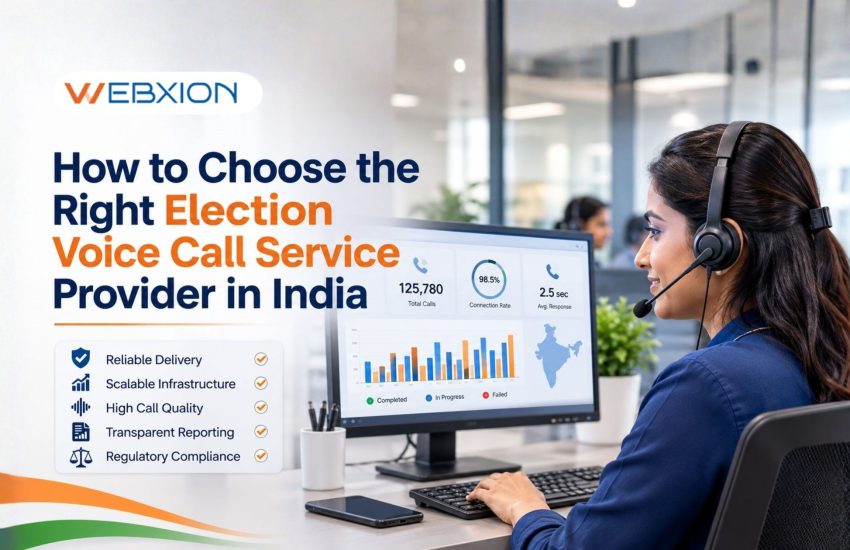
Summary – Choosing the right election voice call service provider in India requires more than comparing call rates. Political parties, election candidates, campaign managers, and political consultants should evaluate bulk voice calling capacity, regional-language support, automated outbound dialer (OBD) features, call analytics, technical support, pricing transparency, and election compliance. A reliable provider should help campaigns communicate at scale while maintaining clear reporting, protecting campaign data, and supporting applicable Election Commission of India (ECI) and telecom requirements.
For campaigns across India, the right platform can simplify voter communication, coordinate public meeting announcements, deliver authorized election-related information, and reduce repetitive manual calling. The key is to choose a provider whose technology, support, and compliance processes match your campaign requirements.
What Is an Election Voice Call Service Provider?
An election voice call service provider offers technology for delivering recorded or automated voice messages to a large number of phone numbers through outbound calling systems. Depending on the platform, these services may include bulk voice broadcasting, automated outbound dialer (OBD) services, interactive voice response (IVR), campaign scheduling, and call performance reports.
Instead of contacting recipients individually, campaign teams can manage authorized voice communication through a centralized platform.
For example, a candidate preparing for an election in Maharashtra may need to announce a public meeting in Marathi, share event information, or communicate an approved campaign message. An automated voice calling platform can help coordinate such communication without requiring staff to dial every number manually.
However, the provider supplies the communication infrastructure; campaign organizers remain responsible for the legality, accuracy, authorization, and appropriate timing of their messages.
Why Is Choosing the Right Election Voice Calling Provider Important?
Election campaigns often operate under tight deadlines, changing schedules, and substantial communication requirements. A provider with inadequate infrastructure or limited reporting can make campaign coordination more difficult.
A suitable election voice broadcasting service can help with:
- Large-scale communication: Coordinate approved voice messages across the intended audience.
- Regional-language outreach: Deliver messages in languages familiar to the target audience.
- Campaign efficiency: Automate repetitive announcements and reminders.
- Performance monitoring: Review call attempts, answered calls, failures, and call duration.
- Centralized management: Schedule campaigns and monitor their progress through one dashboard.
- Operational accountability: Maintain campaign records and review communication outcomes.
For more context, explore these outbound voice calling benefits to understand how automated voice communication can support campaign operations.
10 Factors to Consider When Choosing an Election Voice Call Service Provider in India
1. Can the Provider Handle Your Required Call Volume?
Start by estimating the number of recipients, expected campaign duration, average message length, and required calling window. Then ask the provider about concurrent calling capacity, throughput limits, infrastructure availability, and peak-period support.
Do not assume that a provider capable of handling routine business calls can automatically support your campaign requirements.
Request a demonstration or controlled test and ask how the platform reports failed calls, network-related issues, and completed calls. These details help you assess whether the service matches your operational needs.
2. Does the Provider Support Regional Languages?
India’s linguistic diversity makes regional-language support an important selection criterion.
Depending on your campaign area, you may need voice recordings in Hindi, Marathi, Telugu, Tamil, Bengali, Kannada, or another regional language. The recording should use clear pronunciation, an appropriate speaking pace, and familiar terminology.
For example, a campaign communicating with an audience in Pune or Pimpri-Chinchwad may consider Marathi-language recordings alongside other languages relevant to its intended audience.
Before selecting a provider, listen to sample recordings. Check audio clarity, background noise, voice quality, and whether names, dates, and locations are pronounced correctly.
3. Does It Offer Automated Outbound Dialer and IVR Features?
A bulk election voice call platform may offer several technologies, and understanding their differences helps you choose the right solution.
- Voice broadcasting: Plays a recorded message to recipients.
- Outbound dialer (OBD): Automates outbound call initiation according to configured campaign rules.
- Interactive voice response (IVR): Allows recipients to interact through keypad selections or supported voice inputs.
- AI voice bots: May support conversational interactions, depending on the provider’s capabilities.
Not every campaign needs every feature. If your objective is simply to deliver an approved announcement, a straightforward voice broadcasting service may be sufficient. If you require structured responses or automated call routing, ask whether IVR or other interactive features are available.
4. Are Real-Time Call Reports Available?
A professional provider should explain how it measures campaign performance and make relevant reports accessible.
Look for reporting on:
- Total call attempts
- Answered and unanswered calls
- Failed or incomplete calls
- Call duration
- Campaign completion status
- Available export and reporting options
For example, if a campaign records a high number of unanswered calls, the report should help the team understand the scale of the issue rather than simply displaying the total number of attempted calls.
Remember that an attempted call is not the same as a connected call, and a connected call does not prove that the recipient listened to the complete message. Ask the provider to define its metrics clearly.
5. Is the Election Voice Call Pricing Transparent?
Election voice call service pricing can vary according to call volume, message duration, billing model, platform features, and support requirements.
Before purchasing, ask whether charges are calculated per attempted call, connected call, or call duration. Also clarify setup fees, taxes, credit validity, retry charges, and additional costs for IVR, APIs, or custom integrations.
Compare providers using the same estimated campaign volume and message duration. A low advertised rate may not represent the lowest overall cost if additional charges apply.
For a useful comparison, request a written quotation that explains what is included, what is billed separately, and how unused credits are treated.
6. Can the Platform Scale During Peak Campaign Periods?
Campaign activity can increase quickly as schedules change or major events approach. Your provider should explain its capacity limits, infrastructure arrangements, service availability, and escalation procedures.
Ask what happens if a campaign experiences unexpected traffic, technical delays, or a service interruption. Find out whether the provider offers monitoring, incident communication, and support for rescheduling campaigns when permitted.
Avoid accepting broad guarantees without supporting evidence. Evaluate the provider’s documented capabilities and the specific service commitments included in your agreement.
7. Does It Provide API, CRM, and Campaign Management Integration?
API connectivity and CRM integration can reduce manual work when campaign teams already use authorized management systems.
Depending on the platform, integration may help synchronize campaign records, initiate approved workflows, and associate call outcomes with relevant campaign activities.
Before selecting a provider, check API documentation, access permissions, integration costs, reporting capabilities, and technical support. Confirm that any connected system follows appropriate data-access and security practices.
8. How Strong Are Its Data Security and Privacy Practices?
Campaign contact lists may contain personal information, so data handling should be evaluated before uploading any records.
Ask the provider how contact lists are transferred, stored, accessed, retained, and deleted. Check user permissions, authentication controls, audit logs, and procedures for reporting security incidents.
Campaign organizers should also verify that their data sources and communication practices comply with applicable laws and recipient preferences.
A provider should explain its security practices clearly rather than relying on vague claims about being completely secure.
9. What Technical Support Is Available?
Technical support matters when a scheduled campaign encounters a problem or a recording needs correction before launch.
Check support availability, response procedures, escalation contacts, onboarding assistance, and the process for reporting campaign issues. If your campaign depends on a particular time window, clarify whether assistance will be available during that period.
A useful pre-launch test should cover audio playback, recipient targeting, scheduling, reporting, and any required integrations.
10. Does the Provider Understand Election-Related Compliance?
Compliance should be a central selection criterion, not a final administrative step.
The Election Commission of India has issued directions covering pre-certification of political advertisements, including applicable bulk SMS and voice messages used for election campaigning. The ECI’s official guidance should be consulted alongside current instructions from the relevant election authorities.
Before launching a campaign, verify whether pre-certification is required, which authority handles it, what content must be submitted, and what restrictions apply to the campaign’s timing.
Also review applicable telecom requirements, privacy obligations, recipient preferences, and record-keeping procedures. A provider may support compliance workflows, but its technology alone does not guarantee that a campaign is compliant.
What Election Voice Call Features Should You Look For?
The most suitable feature set depends on your campaign objective.
For straightforward announcements, prioritize reliable voice broadcasting, clear recordings, scheduling, and call reports. For campaigns requiring structured interactions, assess IVR functionality and available response analytics. If your organization needs to connect calling with other systems, investigate API integration and CRM compatibility.
Agencies and communication businesses considering resale may also evaluate a white-label voice calling panel. This can be useful when the platform supports appropriate branding, customer account management, usage reports, and reseller administration.
If you are deciding between traditional IVR and conversational AI for automated voice communication, understanding the difference between IVR and AI voice bots can help you evaluate the right technology. IVR is suitable for predefined menus and structured responses, while AI voice bots can support more natural conversations for appropriate use cases. The right choice depends on your campaign objectives, budget, technical requirements, and applicable election regulations.
Choose features based on actual requirements rather than paying for tools your team will not use.
How Much Does an Election Voice Call Service Cost in India?
There is no single price that applies to every election voice calling campaign. The final cost depends on the provider’s rate structure, estimated call volume, message length, platform features, and additional service requirements.
To compare quotations accurately:
- Provide each provider with the same estimated call volume.
- Specify the expected recording duration.
- Ask how attempted, answered, and duration-based billing works.
- Identify extra charges for IVR, APIs, support, and integrations.
- Confirm taxes, minimum usage, and credit validity.
- Compare the total estimated cost, not just the advertised rate.
This approach helps campaign managers evaluate the likely expenditure without relying on misleading per-call comparisons.
What Election Compliance Requirements Should You Check in India?
Before launching political voice broadcasting, verify the requirements that apply to your particular election and campaign.
The ECI’s official election instructions identify pre-certification requirements for political advertisements on electronic media, including bulk SMS and voice messages. Campaign teams should confirm the applicable process with the relevant Media Certification and Monitoring Committee (MCMC) or election authority.
Your checklist should include:
- Review of political advertisement content and applicable pre-certification.
- Verification of campaign timing and restrictions, including the relevant silence period.
- Assessment of applicable telecom and sender-registration requirements.
- Review of recipient data sources, permissions, and privacy practices.
- Accurate identification of the campaign sender.
- Retention of approvals, scripts, campaign records, and relevant reports.
Requirements may differ according to the election, jurisdiction, and communication type. Do not assume that a telecom registration or a provider’s approval process replaces election-specific certification. Confirm the latest requirements before each campaign.
For additional preparation, use this election campaign compliance checklist to review SMS and voice outreach considerations before deployment.
How Can You Choose the Right Provider Step by Step?
Use a structured evaluation process instead of selecting the first provider offering bulk calling.
Step 1: Define your requirements. Estimate the audience size, message duration, languages, campaign schedule, and reporting needs.
Step 2: Shortlist suitable providers. Compare voice broadcasting, OBD features, IVR, scalability, security, and support.
Step 3: Request a demonstration. Test recording quality, call scheduling, reports, and relevant integrations.
Step 4: Compare complete quotations. Review billing definitions, additional charges, service limits, and applicable contractual commitments.
Step 5: Verify compliance procedures. Confirm who handles content review, required approvals, campaign records, and relevant telecom checks.
Step 6: Test before deployment. Validate the approved recording, schedule, reporting, and technical setup before activating the campaign.
Step 7: Monitor campaign performance. Review available call outcomes, investigate failures, and maintain appropriate records.
This process makes provider selection more transparent and reduces the risk of overlooking important technical or operational requirements.
Why Consider WebXion for Election Voice Call Services?
WebXion offers communication solutions for organizations managing high-volume voice and messaging campaigns. When choosing an Election Voice Call Service Provider, evaluate calling capacity, regional-language support, campaign reports, technical assistance, and compliance requirements.
For integrated election outreach, explore WebXion’s bulk election SMS services and learn how AI-powered voice call solutions support automated communication. You can also compare the difference between IVR and AI voice bots to identify the right technology for your needs.
WebXion also offers communication solutions covering Bulk Voice Calling Services, Outbound Voice Calls Services, IVR Calls Services, Voice OTP Delivery Services, Missed Call Services, AI Voice Bot Services, OTP SMS Services, Transactional SMS Services, Bulk SMS Services, SMS Notification Services, RCS Business Messaging Services, WhatsApp Business API Provider, SMPP Server Service, and AI ChatBots Services, along with guidance on DLT registration.
Planning an election voice campaign or looking for business communication solutions? Contact WebXion to discuss your requirements, explore suitable services, and find an option that fits your budget and communication goals.
Frequently Asked Questions About Election Voice Call Service Providers in India
What is an election voice call service provider?
An election voice call service provider offers technology for delivering recorded or automated voice messages to multiple phone numbers. Depending on its platform, it may support bulk voice broadcasting, OBD calling, IVR, campaign scheduling, and call reports.
How do bulk election voice calls work?
Campaign organizers prepare an authorized message, configure the intended audience and schedule, and use a voice calling platform to initiate calls. The system plays the recording and provides available call outcome reports. Applicable election and telecom requirements must be checked before deployment.
How much does bulk election voice calling cost in India?
Pricing depends on call volume, recording duration, billing method, platform features, and additional charges. Request a written quotation and compare total estimated costs using identical campaign requirements.
What is the difference between OBD and IVR?
OBD automates outbound call initiation and can play recorded messages. IVR allows recipients to interact through configured menus or supported inputs. Some platforms combine both technologies, but their availability and capabilities vary by provider.
Are automated political voice calls permitted in India?
Political voice calls must comply with applicable election laws, ECI instructions, and relevant telecom requirements. Political advertisements delivered through bulk voice messages may require pre-certification. Confirm the current requirements with the relevant election authority before launching a campaign.
Can election voice calls be delivered in regional languages?
Yes, depending on the provider’s recording and language capabilities. Campaign teams should test pronunciation, clarity, speaking pace, and local terminology before approving a recording.
What reports should an election voice calling platform provide?
Useful reports may include attempted calls, answered calls, failed calls, call duration, and campaign completion status. Ask the provider to explain each metric and clarify whether reports distinguish connection from actual message completion.
How do I choose a reliable election voice call service provider?
Compare calling capacity, audio quality, language support, pricing transparency, reporting, security, technical assistance, and compliance processes. Request a demonstration and test the platform before committing to a large campaign.
Can election voice calling work alongside bulk SMS?
Yes. Voice calls and SMS can serve different communication needs. SMS can deliver concise written information, while voice calls can communicate spoken announcements. Both channels must be evaluated against their respective technical and compliance requirements.
Why should campaign managers evaluate compliance before selecting a provider?
A platform may offer the necessary calling technology without automatically ensuring that every campaign complies with election rules. Evaluating certification workflows, timing restrictions, data practices, and documentation requirements in advance helps campaign teams plan responsibly.