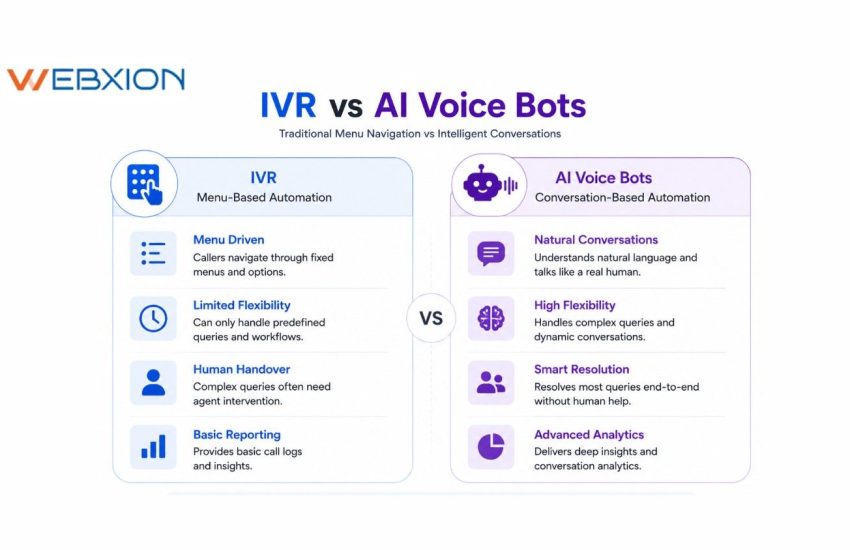
Summary – IVR and AI voice bots both help businesses automate customer calls, but they work very differently. Traditional IVR systems rely on menu-based navigation like “Press 1 for Support,” while AI voice bots use conversational AI, speech recognition, and natural language processing to understand customers naturally. Businesses today are increasingly moving toward AI voice bots because they deliver faster support, personalized interactions, multilingual communication, and a much better customer experience compared to traditional IVR systems.
Customer communication has changed dramatically over the last few years. People no longer want to wait through long phone menus or repeatedly press buttons just to reach the right department. They expect quick, personalized, and human-like conversations — even when interacting with automated systems.
That’s where the conversation around IVR vs AI voice bots becomes important.
Traditional IVR (Interactive Voice Response) systems have been used by businesses for decades to route calls and automate basic support tasks. While they still work well for simple workflows, modern customers often find rigid menu systems frustrating and time-consuming.
AI voice bots are changing that experience completely.
Powered by conversational AI, Natural Language Processing (NLP), and speech recognition technology, AI voice bots can understand natural human speech, respond intelligently, and handle complex customer interactions without sounding robotic. From appointment booking and customer support to lead qualification and payment reminders, businesses are using AI voice bots to automate conversations while improving customer satisfaction.
For example, instead of asking customers to:
“Press 1 for Sales and Press 2 for Support,”
an AI voice bot can simply ask:
“How can I help you today?”
This shift from menu-based automation to intelligent conversation is why industries like healthcare, banking, e-commerce, real estate, and telecom are rapidly adopting AI-powered voice solutions.
In this guide, you’ll learn the real difference between IVR and AI voice bots, how both technologies work, their advantages and limitations, real-world use cases, industry applications, future trends, and which solution is best for your business needs.
What Is IVR?
Understanding Interactive Voice Response (IVR)
IVR Services, or Interactive Voice Response, is an automated telephony system that interacts with callers using voice prompts and keypad inputs.
It helps businesses manage incoming calls without needing a live agent for every interaction.
Common IVR examples include:
- Banking account balance inquiries
- Telecom recharge services
- Appointment confirmations
- Call routing to departments
How IVR Works?
A customer calls a business number and hears automated prompts like:
“Press 1 for English.”
“Press 2 for Billing.”
The caller selects options using keypad inputs or basic voice commands.
The system then routes the call based on predefined rules.
What Are AI Voice Bots?
Understanding AI Voice Bots
AI voice bots are conversational AI systems designed to simulate human-like conversations over voice calls.
Unlike IVR systems, AI voice bots can:
- Understand natural language
- Detect intent
- Personalize conversations
- Learn from interactions
- Handle complex workflows
They use technologies such as:
- Natural Language Processing (NLP)
- Machine Learning
- Speech-to-Text
- Text-to-Speech
- Conversational AI engines
Example of an AI Voice Bot Interaction
Customer:
“I need to book a doctor appointment for Friday evening.”
AI Voice Bot:
“Sure. Dr. Sharma is available at 6 PM and 7:30 PM. Which slot would you prefer?”
This interaction feels natural compared to traditional IVR menus.
IVR vs AI Voice Bots: Quick Comparison Table
Feature | IVR | AI Voice Bots |
Interaction Style | Menu-Based | Conversational |
Customer Input | Keypad/Menu | Natural Voice |
Personalization | Limited | Advanced |
NLP Support | No | Yes |
Learning Capability | Rule-Based | Machine Learning |
Customer Experience | Basic | Human-Like |
Complex Query Handling | Limited | Advanced |
CRM Integration | Basic | Deep Integration |
Multilingual Support | Moderate | Strong |
Automation Capability | Basic | Intelligent Automation |
Best For | Simple Call Routing | Smart Customer Engagement |
How IVR Systems Work?
Step-by-Step IVR Workflow
1. Incoming Customer Call
The system receives the call.
2. Automated Greeting
The customer hears a prerecorded message.
3. Menu Navigation
The caller selects options using the keypad.
4. Call Routing
The system routes the call to a department or agent.
5. Query Resolution
The customer either receives automated information or connects to support.
How AI Voice Bots Work?
Step-by-Step AI Voice Bot Workflow
1. Voice Input
The customer speaks naturally.
2. Speech Recognition
The system converts speech into text.
3. Intent Detection
AI analyzes the customer’s intent using NLP.
4. Response Generation
The AI generates a contextual response.
5. Voice Response
The response is delivered naturally through speech synthesis.
6. CRM & Workflow Integration
The bot updates CRM systems, schedules appointments, or triggers workflows automatically.
Why Are Businesses Moving Beyond Traditional IVR?
Traditional IVR systems solved a major problem decades ago: reducing manual call handling.
However, customer expectations have changed dramatically.
Modern customers expect:
- Instant support
- Personalized responses
- Human-like interactions
- Faster issue resolution
Long IVR menus frustrate users and increase call abandonment rates.
AI voice bots address these issues by creating more natural conversations and reducing customer effort.
Key Benefits of IVR Systems
Despite their limitations, IVR systems still provide value for many businesses.
Advantages of IVR
Cost-Effective
IVR systems reduce the need for large support teams.
24/7 Availability
Customers can access information anytime.
Faster Call Routing
Calls reach the correct department quickly.
Scalable for High Call Volumes
Useful for banks, telecom companies, and utility providers.
Good for Simple Tasks
Ideal for:
- Balance checks
- Order tracking
- Payment confirmations
Key Benefits of AI Voice Bots
1. Human-Like Customer Conversations
AI voice bots make interactions feel natural and engaging.
This improves:
- Customer satisfaction
- Brand perception
- Response rates
2. Personalized Experiences
AI voice bots integrate with CRM systems to personalize interactions.
Example:
“Hi Rahul, your order has been shipped and will arrive tomorrow.”
3. Intelligent Query Handling
AI bots understand customer intent instead of forcing menu navigation.
They can handle:
- Appointment scheduling
- Product inquiries
- Lead qualification
- Customer complaints
4. Multilingual Communication
Businesses in India benefit significantly from multilingual AI voice support.
AI voice bots can communicate in:
- Hindi
- Marathi
- Tamil
- Gujarati
- Bengali
- English
This improves regional customer engagement.
5. Reduced Operational Costs
AI voice bots automate repetitive tasks and reduce dependency on live agents.
Businesses often use them for:
- Outbound campaigns
- Lead nurturing
- Customer support
- Payment reminders
Real-World Business Use Cases
Healthcare Industry
IVR Use Case
Patients press menu options to confirm appointments.
AI Voice Bot Use Case
The bot calls patients, understands responses, reschedules appointments automatically, and sends reminders.
Banking & Finance
IVR Use Case
Balance inquiry and account routing.
AI Voice Bot Use Case
Fraud alert calls, loan eligibility checks, personalized support, and EMI reminders.
Real Estate
AI voice bots qualify property leads automatically by asking:
- Budget
- Preferred location
- Property type
- Visit schedule
This saves sales teams significant time.
E-Commerce
AI voice bots help with:
- Order tracking
- COD confirmations
- Delivery updates
- Return requests
- Customer feedback
Common Challenges With IVR Systems
1. Complex Menu Structures
Too many options frustrate customers.
Common Mistake
Businesses often create 6–8 layer IVR menus.
Expert Tip
Keep IVR flows under three levels whenever possible.
2. Poor Customer Experience
Customers dislike repetitive prompts and long wait times.
Solution
Use AI-powered conversational routing instead of rigid menus.
3. Limited Personalization
Traditional IVR systems cannot fully understand context or customer intent.
Common Challenges With AI Voice Bots
1. Accent & Dialect Recognition
Regional accents can impact recognition accuracy.
Best Practice
Train AI models using regional datasets.
2. Poor AI Training
Untrained bots create robotic or irrelevant conversations.
Solution
Continuously optimize conversational flows using real customer interactions.
3. Integration Complexity
Connecting AI voice bots with CRM, ERP, or telephony systems can be challenging.
Recommendation
Choose scalable cloud telephony platforms with API support.
AI Voice Bot Best Practices
Keep Conversations Natural
Avoid robotic scripts.
Use conversational language similar to human agents.
Use Human Handoff Options
AI should transfer calls smoothly when needed.
This improves customer trust.
Train AI Continuously
Analyze:
- Failed conversations
- Drop-offs
- Customer sentiment
- Resolution rates
Regular optimization improves performance.
Integrate CRM and Analytics
CRM integration allows personalized support and better customer insights.
IVR vs AI Voice Bots: Which Is Better?
The answer depends on business goals.
Choose IVR If:
- You need simple call routing
- Your budget is limited
- You manage predictable workflows
- You handle basic customer inquiries
Choose AI Voice Bots If:
- You want better customer engagement
- You need lead qualification automation
- You handle high customer interaction volumes
- You want multilingual conversational support
- You need intelligent automation
The Rise of Hybrid AI + IVR Systems
Many businesses now combine IVR and AI voice bots.
How Hybrid Systems Work?
Example:
- AI bot greets customer
- AI understands intent
- Smart routing connects the customer
- Human agent takes over when required
This hybrid approach improves both efficiency and customer experience.
Future Trends in AI Voice Automation
Conversational AI Will Become More Human-Like
AI systems are improving rapidly in:
- Emotion detection
- Context understanding
- Personalized recommendations
Voice AI + WhatsApp Integration
Businesses are combining:
- AI voice bots
- WhatsApp Business API
- RCS messaging
- CRM automation
This creates seamless omnichannel communication.
Voice Biometrics & AI Security
Banks and financial institutions are increasingly adopting voice authentication systems.
AI-Powered Predictive Customer Support
Future AI systems will predict customer needs before customers ask for help.
Why Are AI Voice Bots Growing Rapidly in India?
India is one of the fastest-growing markets for AI-powered customer communication.
Major Growth Drivers
Multilingual Population
Businesses need regional language support.
Rapid Digital Adoption
SMEs are adopting cloud telephony and automation tools.
Customer Support Scalability
AI helps businesses manage high call volumes cost-effectively.
DLT Compliance Requirements
Businesses increasingly prefer compliant automated communication systems.
Common Mistakes Businesses Make
Choosing Cheap Automation Over Customer Experience
Low-quality bots damage trust and increase frustration.
Ignoring Human Escalation
Customers still expect human support for complex issues.
Overcomplicating Voice Flows
Too much automation without clarity hurts engagement.
Not Measuring Performance
Businesses should track:
- Call resolution rates
- Average handling time
- Customer satisfaction
- Conversion rates
Expert Recommendations Before Choosing a Solution
Evaluate Customer Interaction Complexity
Simple workflows may only require IVR.
Complex conversations benefit from AI voice bots.
Focus on Customer Experience First
Automation should reduce friction, not create it.
Test Multilingual Support
This is especially important for Indian businesses.
Prioritize CRM Integration
Connected systems create better personalization and reporting.
The Future of Customer Communication: IVR vs AI Voice Bots
Traditional IVR systems helped businesses automate call routing and basic customer support through menu-based interactions. But today’s customers expect faster, more personalized, and human-like communication experiences.
That’s why businesses are increasingly adopting AI Voice Bot Services and AI Chatbot Software to automate conversations more intelligently. Unlike traditional IVR, AI voice bots can understand natural language, provide personalized responses, and improve customer engagement across multiple channels.
Modern businesses are also combining solutions like WhatsApp API Provider services, RCS Service Provider platforms, Promotional Voice Calls Service, Bulk Voice Calling Service, Transactional SMS Service, OTP SMS Service, Voice OTP Delivery Services, Missed Call Services, and Outbound Voice Calls services to create seamless omnichannel communication experiences.
At the same time, infrastructure solutions such as SMPP Server Service, Bulk SMS Reseller Services, Transactional Voice Calls platforms, Toll-free number provider services, DLT Registration, and SMS Notification Service platforms help businesses manage scalable and compliant communication systems.
While IVR systems still work well for simple workflows, AI voice bots are becoming the preferred choice for businesses looking to improve customer experience, automate support, increase engagement, and scale communication more efficiently.
If your business wants smarter and more connected customer communication, connect with WebXion for AI Voice Bot Services, WhatsApp API solutions, Bulk Voice Calling Service, AI Chatbot Software, and intelligent communication platforms designed to improve customer engagement and business growth.
Frequently Asked Questions About IVR Systems
1. What is the main difference between IVR and AI voice bots?
IVR systems use predefined menus and keypad inputs, while AI voice bots use conversational AI and NLP to understand natural language. AI voice bots provide more human-like interactions and can automate complex conversations beyond basic call routing.
2. Can AI voice bots replace IVR systems?
In many cases, yes. AI voice bots can handle customer support, appointment booking, lead qualification, and intelligent call routing. However, many businesses still use hybrid IVR + AI systems for better efficiency and scalability.
3. Which is better for customer service: IVR or AI voice bots?
AI voice bots generally provide a better customer experience because they support conversational interactions, personalization, and faster query resolution. IVR systems work best for simple and predictable workflows.
4. Are AI voice bots expensive?
AI voice bot pricing depends on features, integrations, and usage volume. While implementation costs may be higher initially, businesses often reduce long-term operational costs through automation and improved efficiency.
5. Can AI voice bots understand multiple languages?
Yes. Modern AI voice bots support multilingual communication and can handle regional languages, making them highly effective for diverse customer bases like India.
6. What industries benefit most from AI voice bots?
Healthcare, banking, e-commerce, education, telecom, real estate, and travel industries benefit significantly from AI voice automation due to high customer interaction volumes.
7. How do AI voice bots improve customer engagement?
AI voice bots provide instant responses, personalized interactions, multilingual support, and 24/7 availability, which improves customer satisfaction and engagement.
8. Can AI voice bots integrate with CRM systems?
Yes. Most modern AI voice platforms integrate with CRM systems to personalize conversations, track customer history, automate workflows, and improve reporting.
9. Are AI voice bots suitable for small businesses?
Yes. Cloud-based AI voice solutions are becoming affordable for small and medium businesses looking to automate customer support and lead generation.
10. Are AI voice bots suitable for small businesses?
The future includes emotion-aware AI, predictive customer support, hyper-personalization, multilingual intelligence, and deeper integration with CRM and omnichannel communication platforms.