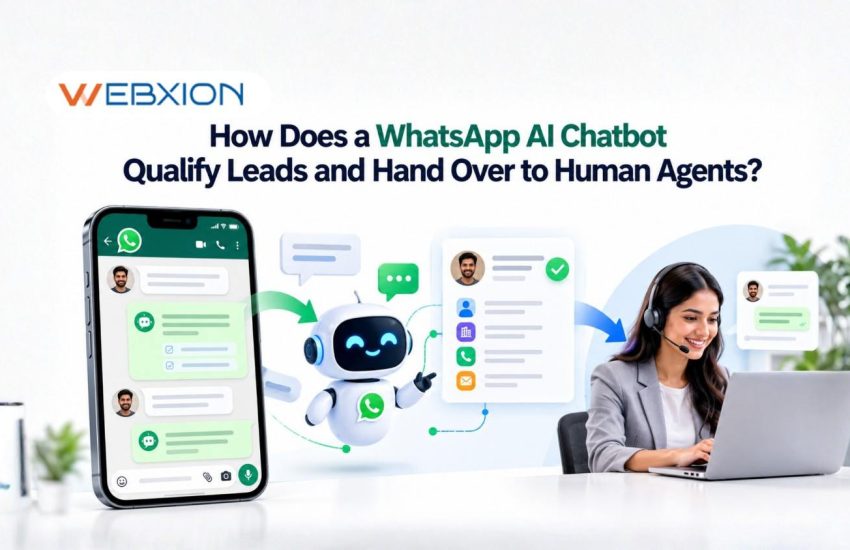
Summary- A WhatsApp AI chatbot qualifies leads by understanding their intent, asking relevant questions, collecting key information, evaluating lead quality, and deciding whether the conversation can be handled automatically or should be transferred to a human agent. When a handoff is required, the best workflows pass the lead’s conversation history, qualification details, and next-best action to the sales representative so the customer does not have to repeat everything.
For businesses using WhatsApp for sales, this creates a practical division of work: AI handles the initial conversation and qualification, while human agents focus on complex questions, high-value prospects, negotiation, and closing.
This approach is particularly useful for businesses in India where WhatsApp is already a familiar channel for enquiries, quotations, demos, appointments, and customer communication.
What Is a WhatsApp AI Chatbot for Lead Qualification?
A WhatsApp AI chatbot for lead qualification is an AI-powered conversational system connected through WhatsApp Business Platform API that interacts with prospects, understands their requirements, collects qualification information, and determines what should happen next.
Unlike a traditional chatbot that mainly provides predefined answers, an AI chatbot can interpret natural-language responses and adjust the conversation according to what the prospect says.
For example, a potential customer might simply message:
“I need WhatsApp API for around 50,000 messages a month.”
Instead of displaying a generic menu, the AI can recognize that this is a business enquiry and continue with relevant questions:
- What is the primary use case?
- What type of messages will you send?
- How many messages do you expect each month?
- When do you want to implement the solution?
- Do you already have a WhatsApp Business setup?
The objective isn’t to ask every visitor the same set of questions. It is to collect enough information to understand whether the prospect is a good fit and determine the appropriate next step.
How Does a WhatsApp AI Chatbot Qualify Leads?
A typical AI lead qualification process follows these stages:
Lead starts conversation → AI identifies intent → AI asks qualification questions → Information is collected → Lead is scored or categorized → Next action is selected → Human handoff when required
1. The Lead Starts a WhatsApp Conversation
A conversation can begin from several sources, including:
- Website WhatsApp buttons
- Click-to-WhatsApp advertising
- QR codes
- Social media campaigns
- Google Business Profile
- Email campaigns
- Product pages
- Existing customer communication
- Offline marketing materials
For example, a digital marketing agency in Pune could place a WhatsApp CTA on its SEO service page.
A visitor might click:
“Talk to an SEO Specialist on WhatsApp.”
The AI chatbot can immediately begin the qualification process rather than waiting for a salesperson to become available.
2. The AI Identifies the Lead’s Intent
The first objective is understanding why the person contacted the business.
The same WhatsApp number might receive messages about:
- Product pricing
- Service enquiries
- Technical support
- Demos
- Sales consultations
- Appointments
- Existing orders
- Complaints
- General information
AI intent detection helps separate these conversations.
For example:
Customer:
“I want to know the pricing for WhatsApp Business API.”
The chatbot can identify this as a potential sales lead.
Another customer might say:
Customer:
“My WhatsApp notifications aren’t being delivered.”
That conversation should probably enter a support workflow instead of a sales qualification flow.
This distinction is important because lead qualification works best when the chatbot understands context and intent, not just keywords.
What Questions Should a WhatsApp AI Chatbot Ask to Qualify a Lead?
The chatbot should ask questions that help determine need, fit, urgency, and buying intent.
The exact questions depend on the business.
For B2B Sales
A chatbot might ask:
- What solution are you looking for?
- What is your current business use case?
- Approximately how many users or customers do you serve?
- What volume do you expect?
- When are you planning to implement the solution?
- Are you currently using another provider?
For Real Estate
The qualification flow could include:
- What type of property are you looking for?
- Which location do you prefer?
- What is your approximate budget?
- Are you buying for personal use or investment?
- When are you planning to purchase?
For Education
Questions could include:
- Which course are you interested in?
- What is your current qualification?
- Which campus or location do you prefer?
- When do you want to start?
- Would you like an admission counsellor to contact you?
For Digital Marketing Services
A chatbot could ask:
- What services are you looking for?
- What is your website URL?
- Which locations do you target?
- What are your main business goals?
- Are you currently running SEO or paid advertising?
- When would you like to start?
The important principle is progressive qualification.
Instead of showing ten questions at once, the AI should ask one relevant question, understand the answer, and decide what information is needed next.
How Does AI Score WhatsApp Leads?
After collecting information, an AI-powered lead qualification system can categorize prospects according to predefined criteria.
This is commonly referred to as lead scoring.
A business might classify leads as:
- Hot: High intent and strong fit
- Warm: Potential fit but requires further nurturing
- Cold: Low immediate buying intent
- Unqualified: Does not meet the business’s target criteria
For example:
Qualification Signal | Lead Quality |
Wants a demo immediately | High |
Has a defined requirement | High |
Budget matches the service | High |
Implementation planned this month | High |
Researching for future use | Medium |
No clear requirement | Low |
Outside service scope | Unqualified |
The scoring model should be based on the company’s actual sales process.
A high website engagement score does not necessarily mean a high-quality sales lead. Buying intent, business fit, budget, timeline, and requirement are often more useful qualification signals.
When Should a WhatsApp AI Chatbot Hand Over to a Human Agent?
A WhatsApp AI chatbot should hand over to a human when automation is no longer the best way to serve the customer.
Common handoff triggers include:
The Customer Requests a Human
If someone says:
“I want to speak with a sales person.”
The chatbot should not keep forcing the automated flow.
A simple response can acknowledge the request and initiate the handoff.
The Lead Has Strong Buying Intent
Suppose a prospect says:
“We want to start next week. Can someone explain the enterprise pricing?”
This is a strong signal that a sales representative should become involved.
The Question Requires Human Judgment
Negotiations, custom pricing, complex integrations, enterprise requirements, contractual questions, and unusual requests may require a person.
The AI Cannot Reliably Answer
If the chatbot repeatedly fails to understand the customer, continuing the automated conversation can create frustration.
A useful rule is:
When confidence decreases and customer impact increases, human intervention becomes more valuable.
The Conversation Is Sensitive or Complex
Some customer interactions should be escalated rather than handled entirely through automation.
The purpose of AI is not to prevent customers from reaching humans. It is to make sure human attention is focused where it adds the most value.
How Does AI-to-Human Handoff Work on WhatsApp?
A well-designed handoff should be more than simply assigning a chat to a salesperson.
The ideal workflow looks like this:
AI conversation → Qualification → Lead score → Handoff trigger → Agent assignment → Context transfer → Human conversation
Step 1: AI Detects the Handoff Trigger
The system identifies signals such as:
- High purchase intent
- Human-agent request
- Complex question
- Pricing negotiation
- Technical requirement
- Low AI confidence
Step 2: Automated Qualification Stops
Once a human agent takes responsibility for the conversation, the system should avoid creating confusion by continuing automated sales messages.
Step 3: The Lead Is Assigned to the Right Agent
Routing can be based on:
- Product
- Service
- Location
- Language
- Lead score
- Sales team
- Industry
- Agent availability
For example, a lead asking about enterprise WhatsApp API integration should ideally reach someone familiar with technical and business requirements rather than a general support representative.
Step 4: Conversation Context Is Transferred
This is one of the most important parts of the process.
The agent should receive the information already collected by the AI.
Step 5: The Human Agent Takes Over
The salesperson can then continue the conversation naturally.
Instead of asking:
“What do you need?”
the agent can say:
“Hi, I’ve reviewed your requirement for WhatsApp API integration and the expected volume of around 50,000 messages per month. Let’s discuss the setup and pricing options.”
That feels significantly more professional because the customer doesn’t have to start from zero.
What Information Should Be Passed to the Human Agent?
The handoff summary should ideally include:
- Lead name
- Company name
- Contact details
- Requirement
- Product or service of interest
- Budget range, when provided
- Expected volume
- Location
- Timeline
- Lead score
- Intent
- Main pain point
- Questions asked
- Customer objections
- Conversation summary
- Recommended next action
For example:
Lead Summary
Company: ABC Technologies
Requirement: WhatsApp Business Platform
Estimated volume: 50,000 messages/month
Use case: Customer notifications
Timeline: Within 30 days
Intent: High
Current solution: Existing SMS provider
Next action: Sales consultation
This gives the sales representative immediate context.
How Does a WhatsApp AI Chatbot Route Leads to the Right Sales Agent?
Lead routing is especially important for businesses with multiple sales teams.
A chatbot can route prospects according to predefined rules.
Product-Based Routing
A lead interested in WhatsApp API goes to the WhatsApp sales team, while an AI chatbot enquiry goes to the AI solutions team.
Location-Based Routing
Businesses serving multiple cities can route leads based on location.
For example, enquiries from Pune, Pimpri-Chinchwad, Mumbai, Delhi, Bengaluru, or other Indian markets can be distributed according to the organization’s sales structure.
Industry-Based Routing
A healthcare enquiry can go to a healthcare specialist, while a B2B SaaS lead can go to a SaaS sales representative.
Lead-Score Routing
High-value leads can be prioritized for senior sales representatives.
Language-Based Routing
For businesses serving different Indian regions, language preferences can also influence routing.
The goal is simple:
Get the right lead to the right person at the right time.
How Does WhatsApp AI Lead Qualification Integrate With a CRM?
A WhatsApp AI chatbot becomes considerably more useful when connected to a CRM for WhatsApp lead generation.
Instead of leaving customer information inside a chat window, the system can pass relevant information into the company’s sales pipeline.
Depending on the integration, this can include:
- Creating a new lead
- Updating an existing contact
- Adding tags
- Assigning lead scores
- Updating lead status
- Recording source
- Assigning an account manager
- Creating follow-up tasks
- Saving conversation information
For example:
WhatsApp → AI qualification → CRM lead creation → Lead score → Sales assignment → Follow-up → Conversion
This creates a more measurable sales process.
Marketing teams can also identify which campaigns generate qualified leads rather than simply counting WhatsApp conversations.
What Does a Real WhatsApp AI Lead Qualification Conversation Look Like?
Consider a company selling WhatsApp Business solutions.
Customer
“I want WhatsApp API for my business.”
AI Chatbot
“Sure. What would you mainly use WhatsApp for—marketing, customer notifications, support, or sales?”
Customer
“Customer notifications and order updates.”
AI Chatbot
“Got it. Approximately how many WhatsApp messages do you expect to send each month?”
Customer
“About 50,000.”
AI Chatbot
“Thanks. Are you currently sending these notifications through SMS, another WhatsApp API provider, or a different system?”
Customer
“We currently use SMS.”
AI Chatbot
“Understood. Are you planning to move your notifications to WhatsApp this month?”
Customer
“Yes.”
AI Chatbot
“Your requirement looks suitable for a WhatsApp Business solution. I’ll connect you with our specialist to discuss the setup, integration and pricing.”
Human Agent
“Hi, I’m Rahul from the WhatsApp solutions team. I’ve reviewed your requirement for approximately 50,000 monthly notifications and your plan to move from SMS to WhatsApp. I can walk you through the integration and pricing options.”
This is the ideal relationship between AI and human support.
AI qualifies. Human consults.
WhatsApp AI Chatbot vs Human Sales Agent: Who Should Handle What?
AI and human agents are not necessarily competing solutions, and this approach can help reduce customer support costs.
They perform different jobs.
Task | AI Chatbot | Human Agent |
Answer common FAQs | ✓ | ✓ |
Initial lead qualification | ✓ | ✓ |
Collect basic requirements | ✓ | ✓ |
Lead scoring | ✓ | ✓ |
24/7 first response | ✓ | ✓ |
Complex requirements | ✓ | |
Negotiation | ✓ | |
Custom pricing | ✓ | |
High-value prospects | ✓ | |
Relationship building | ✓ | |
Complex objections | ✓ | |
Closing important deals | ✓ |
The strongest implementation uses both.
What Are the Benefits of WhatsApp AI Lead Qualification?
Faster Response to New Enquiries
A prospect doesn’t necessarily need to wait for office hours before receiving an instant AI response.
Better Sales-Team Productivity
Sales representatives spend less time collecting basic information and more time speaking with qualified prospects.
Consistent Qualification
AI can follow defined qualification criteria consistently.
Better Lead Prioritization
Sales teams can identify which enquiries deserve immediate attention.
Fewer Missed Opportunities
A structured WhatsApp workflow can capture information even when a salesperson isn’t immediately available.
Better Customer Experience
When the handoff is done correctly, customers don’t have to repeat information already shared with the chatbot.
What Mistakes Should Businesses Avoid?
Asking Too Many Questions
A chatbot that behaves like a 15-field form can quickly lose the customer.
Using the Same Script for Every Lead
A customer asking about pricing should not receive the same conversation as someone asking for technical support.
Hiding the Human Option
Customers should have a clear path to human assistance when automation isn’t appropriate.
Losing Conversation Context
Transferring a conversation without the qualification data creates unnecessary friction.
Poor Agent Routing
A qualified enterprise lead should not disappear into an unmonitored general inbox.
Continuing AI Messages After Handoff
Once a human takes ownership, the customer should know who they are communicating with.
Measuring Conversations Instead of Business Outcomes
A chatbot can have thousands of conversations and still generate poor business results.
The more meaningful metrics are qualified leads, appointments, demos, opportunities and conversions.
How Can You Build an Effective WhatsApp AI Lead Qualification Workflow?
Step 1: Define Your Ideal Customer Profile
Identify the customers most likely to purchase.
Step 2: Define Qualification Criteria
Determine which information actually affects your sales decision.
Step 3: Build the Conversation Flow
Create natural questions based on customer intent.
Step 4: Establish Lead-Scoring Rules
Define what makes a lead hot, warm, cold or unqualified.
Step 5: Define Handoff Triggers
Specify exactly when a human should take over.
Step 6: Connect Your CRM
Make sure qualified information reaches the sales pipeline.
Step 7: Configure Agent Routing
Assign conversations based on product, industry, geography, language, lead score or other business rules.
Step 8: Test Real Scenarios
Test:
- High-intent leads
- Low-intent leads
- Confused customers
- Customers requesting humans
- Pricing questions
- Complex technical enquiries
- After-hours conversations
Step 9: Continuously Improve
Review conversations and identify where prospects drop off or where the AI frequently requires human intervention.
Which Metrics Should You Track?
A good WhatsApp AI lead qualification strategy should be measured beyond chatbot usage.
Track:
- First response time
- Lead qualification rate
- Qualified lead percentage
- Hot-lead percentage
- Human handoff rate
- Conversation completion rate
- Lead drop-off rate
- Demo booking rate
- Appointment rate
- Lead-to-opportunity conversion
- Lead-to-sale conversion
- Average sales response time
- AI resolution rate
For example, if 1,000 people start WhatsApp conversations but only 20 become qualified opportunities, increasing the number of chatbot conversations isn’t necessarily the answer.
The business should investigate where qualification is failing.
Is a WhatsApp AI Chatbot Better Than a Traditional Lead Form?
It depends on the sales process.
A traditional form typically follows:
Landing page → Form → Submission → Sales notification → Follow-up
A conversational WhatsApp workflow can follow:
Ad/website → WhatsApp → Conversation → Qualification → Lead score → Human handoff → Sales follow-up
Forms work well when the required information is straightforward.
WhatsApp AI can be particularly useful when qualification depends on conversation, follow-up questions, customer intent, or different possible paths.
For high-consideration services, the conversational approach can provide additional context that a basic form may not capture.
How Can Different Industries Use WhatsApp AI Lead Qualification?
Real Estate
AI can qualify prospects based on:
- Property type
- Preferred location
- Budget
- Buying purpose
- Timeline
A high-intent buyer can then be connected with a property consultant.
Education
AI can identify:
- Course preference
- Qualification
- Location
- Intake period
- Admission intent
The lead can then be handed to an admission counsellor.
Healthcare
AI can assist with basic appointment-related enquiries and routing while ensuring conversations that require professional judgment are escalated appropriately.
B2B SaaS
AI can ask about:
- Company size
- Use case
- Number of users
- Existing software
- Integration requirements
- Implementation timeline
High-fit prospects can then be routed to sales or a solutions consultant.
Digital Marketing
A chatbot can qualify prospects based on:
- Website
- Service requirement
- Target location
- Current marketing activity
- Business objective
- Approximate budget
- Desired timeline
For a Pune-based agency, for example, the same workflow can distinguish a local SEO requirement for Pune or Pimpri-Chinchwad from a national SEO campaign targeting customers across India.
The geographic information becomes useful when it affects service delivery, campaign targeting or sales assignment—not simply because a location keyword needs to be added.
How Much Does a WhatsApp AI Lead Qualification Chatbot Cost?
There is no single fixed price because the total cost depends on the implementation.
Typical cost components can include:
- WhatsApp Business Platform usage
- AI model usage
- Chatbot software
- Conversation management
- CRM integration
- Initial setup
- Custom development
- Human-agent inbox
- Maintenance and optimization
A simple FAQ chatbot and an AI-powered sales qualification system with CRM integration, lead scoring and agent routing are very different projects.
Businesses should therefore evaluate the total workflow and expected business outcome, rather than comparing providers only on chatbot setup cost.
How WebXion Helps Businesses Turn WhatsApp Conversations Into Qualified Leads?
A WhatsApp AI chatbot works best when it becomes part of a structured sales and customer communication workflow, rather than functioning as a simple automated reply system. With the right setup, businesses can use AI to understand customer intent, ask qualification questions, collect important lead information, and identify when a conversation needs human attention.
A practical WhatsApp AI lead qualification workflow looks like this:
Start the conversation → Understand intent → Ask relevant questions → Collect lead information → Qualify and score the lead → Identify the next action → Hand over to a human agent when required → Continue with full conversation context.
The value isn’t just faster responses. The real advantage is helping sales teams spend more time on qualified prospects, high-intent enquiries, complex requirements, and conversations that are closer to conversion.
How WebXion Can Support WhatsApp AI Lead Qualification?
WebXion helps businesses use WhatsApp Business Platform, AI chatbots, conversational automation, CRM integrations, and human-agent workflows to create a more structured customer communication process.
For example, a business receiving hundreds of WhatsApp enquiries can configure its AI chatbot to first understand what each customer needs. The chatbot can collect information such as the customer’s requirement, expected volume, location, budget, timeline, or product interest. Based on the responses, the conversation can then be categorized and routed to the appropriate sales or support team.
For a high-intent lead, the workflow might look like:
WhatsApp enquiry → AI conversation → Lead qualification → Lead scoring → CRM update → Sales-agent assignment → Human conversation
When the human agent receives the conversation, they can have access to the information already collected by the AI instead of asking the customer to explain the same requirement again.
This creates a smoother experience for both sides.
For businesses operating in Pune, Mumbai, Delhi, Bengaluru and other Indian markets, this type of WhatsApp automation can also support location-based lead routing, sales-team assignment and region-specific customer conversations.
Ready to Build a Smarter WhatsApp Sales Workflow?
If you’re planning to use WhatsApp AI for lead qualification, AI chatbot automation, CRM integration, customer support or AI-to-human handoff, WebXion can help you build the right communication workflow for your business.
WebXion supports WhatsApp Business API Provider, AI ChatBots services, RCS Business Messaging services, SMS Notification services, OTP services, transactional SMS services, Bulk Promotional SMS Services, Bulk SMS Reseller Services, SMPP Server Service, and DLT Registration.
For voice-based communication, WebXion also provides Outbound Voice Calls services, Bulk voice calling service, IVR Calls Services, Missed Call Services, AI Voice Bot Services, and Voice OTP Delivery Services.
Instead of choosing separate tools, identify where your business needs automation, faster responses, secure notifications, lead qualification, or human support.
Contact WebXion to discuss your WhatsApp AI, messaging, SMS and voice communication requirements and build a smarter, scalable customer communication workflow.
Frequently Asked Questions
Can a WhatsApp AI chatbot qualify leads automatically?
Yes. A WhatsApp AI chatbot can ask predefined or context-aware questions, collect information about the prospect’s requirement, evaluate qualification criteria and categorize or route the lead.
Can a WhatsApp chatbot transfer a lead to a human?
Yes. A properly designed WhatsApp chatbot workflow can provide a human-agent escalation path and transfer the conversation when predefined conditions are met.
When should a WhatsApp chatbot hand over to a human?
Common triggers include a direct request for a human, high purchase intent, complex questions, negotiation, sensitive conversations, technical requirements, or situations where the AI cannot confidently provide an appropriate response.
Can AI score leads on WhatsApp?
Yes. Lead-scoring rules can consider factors such as buying intent, business fit, budget, timeline, requirement, engagement and other criteria defined by the business.
Can WhatsApp AI chatbots integrate with CRM systems?
Yes. Depending on the platform and integration, lead information collected during the WhatsApp conversation can be sent to a CRM for lead creation, tagging, scoring, assignment and follow-up.
What information should an AI chatbot collect from a lead?
The information depends on the business. Common qualification data includes name, company, requirement, product interest, location, budget, timeline, use case, expected volume and decision-making status.
Can WhatsApp AI chatbots work 24/7?
AI chatbots can provide automated responses outside normal business hours. However, human-agent availability depends on the company’s sales and support operations.
Should AI completely replace human sales agents?
No. AI is generally most useful for initial engagement, qualification, information collection and routine interactions. Human agents remain important for complex requirements, negotiation, relationship building and high-value sales conversations.
What happens when a human agent takes over?
The best workflows provide the agent with the relevant conversation history and qualification information so the customer does not have to repeat their requirement.
How can businesses improve WhatsApp lead conversion?
Start by improving qualification quality rather than simply increasing message volume. Define your ideal customer, ask useful questions, identify high-intent signals, create clear handoff rules, route leads correctly and measure conversion from WhatsApp conversation to qualified opportunity and sale.