Summary – WebXion’s AI Chatbots can help businesses reduce customer support costs by automating repetitive questions, providing 24/7 assistance, handling multiple conversations simultaneously, and transferring complex issues to human agents. Depending on query volume, automation rate, staffing model, and implementation, businesses may significantly reduce support workload and operating costs while improving response times and customer experience.
Customer support can become expensive long before a business realizes it.
As customer inquiries increase, companies often need more support agents, longer operating hours, additional training, and larger teams to manage repetitive questions. For businesses handling hundreds or thousands of customer conversations every day, even small inefficiencies can quickly become significant operating costs.
This is where AI-powered customer support chatbots can make a measurable difference.
WebXion’s AI Chatbot Services help businesses automate routine conversations, answer common questions instantly, support customers around the clock, and route complex issues to human teams when needed. The objective is not simply to replace customer service agents. It is to help businesses use their support teams more efficiently.
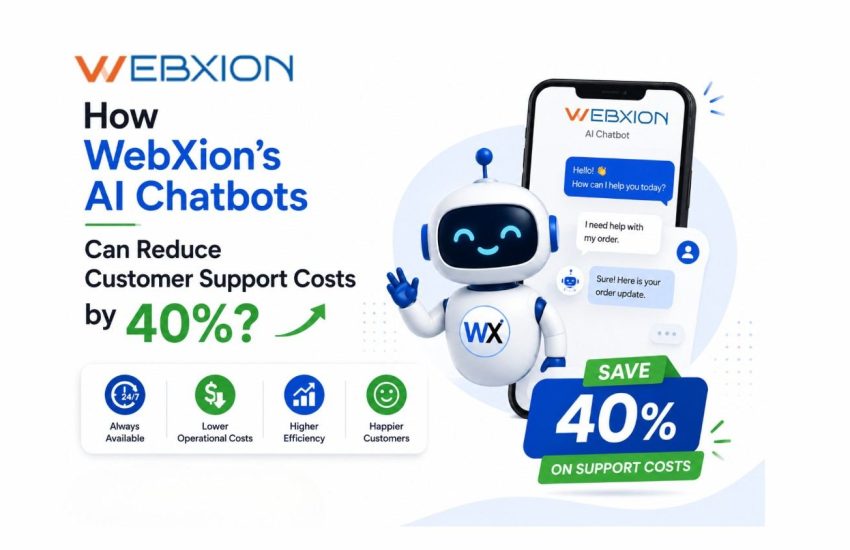
In the right environment, this type of automation can contribute to up to 40% lower customer support costs, particularly when a large portion of incoming queries is repetitive and suitable for automation.
But how does that cost reduction actually happen?
Why Are Customer Support Costs Increasing?
Before looking at AI automation, it is important to understand where traditional support costs come from.
A typical customer support operation may spend money on:
- Salaries and benefits for support agents
- Training and onboarding
- Customer support software
- Call center infrastructure
- Night and weekend support
- Ticket management
- Repetitive query handling
- Customer follow-ups
- Quality monitoring
- Scaling teams during peak periods
Consider an e-commerce company receiving 5,000 customer inquiries every month.
If a large percentage of those conversations are questions such as “Where is my order?”, “What is your return policy?”, “How can I cancel my order?”, or “What payment methods do you accept?”, assigning human agents to every conversation is inefficient.
An AI chatbot can answer many of these questions automatically, allowing human agents to concentrate on complaints, escalations, refunds, complex transactions, and customers who genuinely need personal assistance.
That is where the cost-saving opportunity begins.
How Do AI Chatbots Reduce Customer Support Costs?
AI chatbots reduce support costs primarily by automating repetitive work and increasing the productivity of existing support teams.
Here are the major ways they can contribute to lower operational expenses.
1. Automating Repetitive Customer Questions
Frequently asked questions consume a considerable amount of agent time.
An AI chatbot can respond instantly to common queries about:
- Products and services
- Pricing
- Business hours
- Policies
- Order status
- Delivery information
- Appointments
- Account-related information
- Basic troubleshooting
- Frequently requested documents
Instead of an agent answering the same question dozens or hundreds of times, the chatbot can provide the relevant information automatically.
This reduces ticket volume and gives support employees more time for high-value conversations.
2. Providing 24/7 Customer Support
Customers do not always contact businesses during working hours.
Someone may need help at 11 PM, early in the morning, or during a weekend. Traditional support requires businesses to maintain extended shifts or accept delays until agents become available.
AI chatbots can provide automated assistance 24/7.
For businesses serving customers across India, this can be especially useful because customers may contact brands at different times and through different digital channels.
A customer in Pune, Mumbai, Delhi, Bengaluru, or Hyderabad should not necessarily have to wait until the next business day for an answer to a simple question.
3. Handling Multiple Conversations Simultaneously
A human agent can only manage a limited number of conversations at once.
An AI chatbot can handle many conversations simultaneously.
This becomes particularly valuable during:
- Sales campaigns
- Product launches
- Seasonal shopping periods
- Admissions
- Insurance renewals
- Promotional campaigns
- Service disruptions
- High-demand periods
Instead of immediately increasing headcount whenever inquiry volume rises, businesses can use automation to absorb a portion of the additional workload.
4. Reducing First-Level Support Work
Customer service usually follows different levels of support.
First-level teams deal with basic questions. More experienced agents handle complicated cases.
AI chatbots can automate a significant portion of first-level interactions.
For example, a telecom company may receive questions about recharge options, plan details, validity, or account information. A chatbot can manage straightforward requests while forwarding complicated complaints to an appropriate support representative.
This creates a more efficient human + AI support model.
5. Reducing Customer Waiting Time
Cost reduction is not the only benefit.
Customers also expect quick answers.
When customers have to wait several minutes—or sometimes several hours—for a basic response, frustration increases. An AI chatbot can respond immediately to supported questions.
That can improve:
- First response time
- Customer satisfaction
- Resolution speed
- Support team efficiency
- Overall customer experience
The best implementation therefore focuses on reducing unnecessary human workload without reducing service quality.
How Does WebXion’s AI Chatbot Work?
A practical AI chatbot workflow can look like this:
Step 1: Customer starts a conversation
The customer asks a question through the supported communication channel.
Step 2: AI understands the intent
The chatbot identifies what the customer is trying to accomplish rather than simply matching individual keywords.
Step 3: Relevant information is provided
The chatbot responds using the business’s approved information and conversation logic.
Step 4: Follow-up questions are handled
Customers can continue the conversation naturally instead of starting over with every question.
Step 5: Complex issues are escalated
If the request requires human intervention, the conversation can be transferred to an appropriate support team.
Step 6: Businesses monitor performance
Companies can review conversation patterns, unanswered questions, automation rates, and customer interactions to improve the chatbot over time.
This human handoff is important. A good customer support chatbot should know when not to continue the conversation by itself.
Can WebXion AI Chatbots Really Reduce Support Costs by 40%?
Potentially, yes—but 40% should be treated as a business-specific target or outcome, not a guaranteed saving for every company.
The actual reduction depends on factors such as:
- Number of monthly customer queries
- Percentage of repetitive queries
- Chatbot automation rate
- Existing support team size
- Support operating hours
- Number of channels being automated
- Integration requirements
- Complexity of customer requests
- Quality of chatbot training
For example, imagine a company receives 10,000 monthly support conversations and 50% involve simple, repetitive questions.
If an AI chatbot successfully resolves a substantial portion of those interactions, human agents may handle significantly fewer routine requests. The company could potentially serve a larger customer base without increasing its support team at the same rate.
The important metric is not simply “How many chats did the chatbot handle?”
Businesses should ask:
“How much human support workload did the chatbot actually remove?”
That is a much more meaningful measure of ROI.
What Customer Queries Can AI Chatbots Handle?
WebXion AI Chatbots can be designed around the specific needs of a business.
Common applications include:
E-commerce
- Order tracking
- Product questions
- Return policies
- Delivery information
- Payment-related FAQs
Healthcare
- Appointment information
- Department details
- Basic patient queries
- Hospital service information
- Appointment reminders
Education
- Course information
- Increase Admission
- Application guidance
- Fee-related questions
- Student support
Real Estate
- Property inquiries
- Project information
- Lead qualification
- Site-visit requests
- Location-based questions
Banking and Financial Services
- General product information
- Service FAQs
- Application guidance
- Basic account support
Insurance
- Policy information
- Renewal reminders
- General claim guidance
- Customer FAQs
The chatbot should always operate within appropriate business rules, security requirements, and regulatory considerations.
How Do AI Chatbots Improve Customer Support Without Replacing Agents?
This is one of the most important questions businesses should ask.
AI chatbots work best when they augment human agents rather than blindly replace them.
Suppose a customer asks, “What is your return policy?”
That is a good automation candidate.
But if the customer says, “My payment was deducted twice and I need immediate help,” the situation may require human intervention.
A practical support model is therefore:
AI handles routine interactions → AI identifies complex issues → Human agent handles the escalation.
This approach can reduce repetitive workload while allowing support professionals to spend more time solving difficult problems.
How Can Businesses Measure AI Chatbot ROI?
Businesses should measure the chatbot using operational and customer-experience metrics.
Important KPIs include:
- Automation rate: Percentage of conversations resolved without human intervention
- Ticket reduction: Number of support tickets reduced through automation
- Average response time: How quickly customers receive answers
- First-contact resolution: Percentage of queries resolved during the initial interaction
- Agent productivity: Number and complexity of cases handled by agents
- Cost per interaction: Average cost of supporting each customer
- Customer satisfaction: Feedback after chatbot interactions
- Escalation rate: Percentage of conversations transferred to human agents
A simple approach is to compare support costs before and after implementation while accounting for chatbot setup, integration, maintenance, and platform expenses.
This provides a more realistic picture of whether automation is actually producing financial value.
How Can Indian Businesses Use AI Chatbots for Customer Support?
For Indian businesses, AI chatbots can be particularly useful because customers often expect fast communication through digital and mobile-first channels.
Businesses serving customers in cities such as Pune, Mumbai, Bengaluru, Delhi, Hyderabad, Chennai, Ahmedabad, and Gurugram can use automated conversations to handle high volumes of customer inquiries without relying entirely on traditional call-based support.
Multilingual or localized conversational experiences can also help businesses communicate with broader customer segments.
For companies already using channels such as WhatsApp API Provider, SMS Notification Service, RCS Service Provider, or Outbound Voice Calls services, AI chatbot automation can become part of a broader customer communication strategy.
The goal is to create a connected support experience rather than forcing customers to repeatedly switch between disconnected channels.
What Should Businesses Consider Before Implementing an AI Chatbot?
AI chatbot implementation should begin with the business problem—not the technology.
Start by identifying your most repetitive support queries.
Then determine:
- Which questions can safely be automated?
- Which conversations require human support?
- Which systems need integration?
- What information should the chatbot access?
- When should conversations be escalated?
- Which performance metrics will determine success?
Avoid trying to automate everything on day one.
A better approach is to begin with high-volume, low-complexity queries, measure the results, and gradually expand automation.
This improves accuracy and reduces the risk of creating frustrating customer experiences.
Ready to Make Customer Support Faster and More Cost-Effective?
AI chatbots can take care of repetitive customer questions, provide 24/7 assistance, and help your support team focus on conversations that genuinely need human attention. But businesses can go further by connecting chatbot automation with the right communication channels. From choosing a reliable WhatsApp API Provider or RCS Service Provider to using AI Voice Bot Services, OTP SMS Service, Transactional SMS Service, SMS Notification Service, Voice OTP Delivery Services, and missed call service, businesses can build a more connected customer communication experience.
For large-scale communication, a reliable SMPP Server Service, Bulk SMS Reseller Services, Promotional Voice Calls Service, Bulk Voice Calling Service, Outbound Voice Calls services, or Transactional Voice Calls Reseller can help businesses manage high-volume messaging and voice communication. Businesses may also need a trusted Toll-free number provider and proper DLT Registration to support compliant communication in India.
If you are looking to combine AI Chatbot Software with WhatsApp, RCS, SMS, and voice automation, Connect with WebXion to discuss your requirements. The right communication strategy can help you reduce repetitive support work, respond to customers faster, and scale customer engagement without continuously increasing your support costs.
Frequently Asked Questions About AI Chatbots and Support Costs
Can AI chatbots reduce customer support costs?
Yes. Banks can use WhatsApp API to commu
Yes. AI chatbots can reduce support costs by automating repetitive queries, providing 24/7 assistance, handling multiple conversations simultaneously, and reducing the workload placed on human agents. The actual savings depend on the business’s query volume, automation rate, staffing model, chatbot capabilities, and implementation strategy.
nicate KYC reminders, status updates, instructions, and onboarding information. The actual verification process should follow the bank’s approved and applicable KYC procedures.
How much can a business save with an AI chatbot?
There is no universal savings percentage. Businesses with high volumes of repetitive customer queries may achieve significant reductions in support workload and operating costs. A figure such as 40% should be treated as a potential target or business-specific outcome rather than a guaranteed result.
Can AI chatbots replace customer support agents?
Not completely. AI chatbots are most effective at handling repetitive and straightforward questions, while human agents remain important for complex, sensitive, or unusual cases. A human-agent escalation process allows businesses to combine automation with personalized support.
Can AI chatbots provide 24/7 customer support?
Yes. AI chatbots can provide automated assistance outside normal business hours. This allows customers to receive immediate answers to supported questions without requiring businesses to maintain a full human support team around the clock.
Which industries benefit most from AI chatbots?
E-commerce, healthcare, education, banking, insurance, real estate, logistics, travel, retail, and telecom businesses can all benefit from AI chatbot automation, particularly when they receive large numbers of repetitive customer inquiries.
How do I calculate AI chatbot ROI?
Compare your existing customer support costs with the costs after automation. Include agent workload, ticket volume, response time, automation rate, chatbot implementation costs, and customer satisfaction. The strongest ROI comes when automation reduces workload while maintaining or improving customer experience.