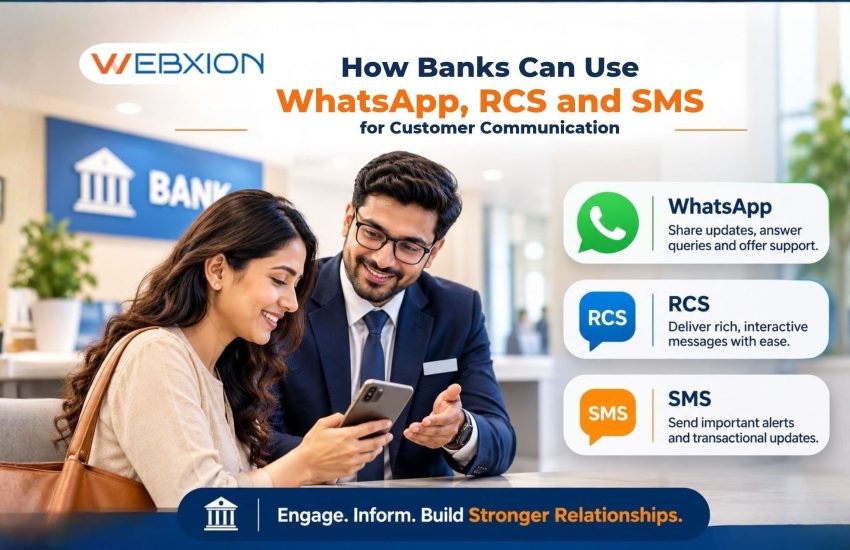
Summary – Banks can use WhatsApp, RCS Business Messaging, and SMS to deliver transaction alerts, OTPs, payment reminders, account updates, promotional messages, and customer support. Each channel serves a different purpose: WhatsApp supports interactive conversations, RCS delivers rich and branded messages, while SMS provides broad reach for essential notifications. By combining all three through an omnichannel communication platform, banks can improve customer engagement, deliver timely updates, and make digital banking more convenient.
Banks need to keep customers informed about transactions, OTPs, loan applications, payment reminders, and account updates. To make communication faster and more convenient, many financial institutions are using WhatsApp Business API, RCS Business Messaging, and SMS.
Each channel serves a different purpose. WhatsApp supports customer conversations and AI chatbot automation, RCS enables rich and interactive messages, while SMS remains a reliable option for OTPs and essential banking alerts.
By combining these channels through CPaaS solutions, banks can automate routine notifications, improve customer engagement, and deliver a smoother digital banking experience. This guide explores how banks in India can use WhatsApp, RCS, and SMS effectively for customer communication.
Why Is Digital Customer Communication Important for Banks?
Customers expect banks to provide quick updates whenever they make a transaction, apply for a loan, pay a credit card bill, or raise a service request. Delayed notifications or unclear communication can create confusion and increase the number of calls to customer support.
Traditional communication methods alone may not meet these expectations. Banks need digital messaging channels that can handle high volumes, support different customer preferences, and deliver important information reliably.
WhatsApp, RCS, and SMS help banks:
- Send real-time transaction alerts and account notifications.
- Deliver OTPs and authentication messages.
- Share loan application and credit card updates.
- Remind customers about EMI payments and due dates.
- Provide customer support through automated messaging.
- Communicate important service updates and security alerts.
For Indian banks and financial institutions, these channels are particularly useful because customers have different levels of internet access, smartphone compatibility, and digital banking preferences. A combination of messaging channels helps banks communicate with more customers without depending on a single platform.
How Can Banks Use WhatsApp Business API for Customer Communication?
The WhatsApp Business API, also known as the WhatsApp Business Platform, allows banks to communicate with customers through automated notifications, interactive messages, and chatbot-powered conversations. Unlike ordinary one-to-one messaging, API-based communication can connect WhatsApp with banking applications, CRM systems, and customer support platforms.
Here are some practical banking use cases.
1. Transaction Alerts and Account Notifications
Banks can send customers notifications about debit transactions, credit transactions, payment confirmations, and other account activities through approved WhatsApp messaging workflows.
For example, after a customer makes a UPI payment or uses a debit card, the bank can send a transaction notification with relevant details. This helps customers recognise account activity and identify transactions they do not recognise.
2. KYC Updates and Document Reminders
Banks can use WhatsApp to notify customers about pending KYC verification, document requirements, and application status updates. Customers can receive instructions and follow the appropriate secure process to complete their requirements.
For example, a customer applying for a savings account may receive a reminder that identity verification is incomplete. The message can direct them to the bank’s official secure channel for the next step.
Learn more about WhatsApp API for banking and how it supports KYC updates and transaction alerts.
3. Loan and Credit Card Updates
Banks can use WhatsApp notifications to share loan application progress, credit card dispatch updates, payment reminders, and service request status.
These automated updates reduce repetitive enquiries and help customers stay informed without repeatedly contacting a branch or call centre.
4. Customer Support Through WhatsApp Chatbots
AI-powered WhatsApp chatbots can answer common questions about banking services, branch timings, loan procedures, credit card payments, and application status.
When a customer asks a question, the chatbot can provide an automated response based on approved information. If the request requires account-specific verification or human assistance, the conversation can be transferred to an authorised support representative.
For banks, this creates a convenient support channel while helping service teams manage routine enquiries more efficiently.
How Can Banks Use RCS Business Messaging to Improve Customer Engagement?
RCS (Rich Communication Services) is an advanced messaging technology that adds rich media and interactive features to traditional text messaging. RCS Business Messaging allows banks to send branded messages with images, buttons, cards, and other interactive elements on supported devices and networks.
Unlike a standard SMS, an RCS message can provide a more visual and engaging customer experience.
1. Send Interactive Banking Notifications
Banks can use RCS messages to share payment reminders, loan updates, service announcements, and account-related notifications with interactive buttons.
For example, a credit card customer may receive a payment reminder with a button that directs them to the bank’s official payment page.
2. Promote Banking Products and Services
RCS can help banks present information about savings accounts, fixed deposits, credit cards, personal loans, and other financial products through branded message layouts.
Rather than sending a plain promotional message, banks can use rich cards to explain product features and guide customers towards relevant information.
Promotional communication should follow applicable consent and messaging requirements.
3. Build Trust Through Verified Business Identity
RCS Business Messaging can support verified business profiles, helping customers recognise the organisation sending a message. This is especially valuable in banking, where customers need to distinguish genuine communications from impersonation attempts.
However, verification does not replace customer awareness, secure authentication, or fraud-prevention controls.
4. Improve Customer Interaction
RCS buttons and suggested replies can make it easier for customers to respond to messages, explore services, or take the next step.
Banks can use these interactive features for service enquiries, appointment assistance, and product information, depending on device and carrier support.
Explore RCS Business Messaging services to understand how rich and interactive messaging can support customer communication.
How Do Banks Use SMS Services for Transaction Alerts and OTP Delivery?
SMS remains an important communication channel for banks because it can reach mobile phones without requiring an internet connection or a specific messaging application.
Banks use SMS for essential notifications where broad mobile reach and straightforward delivery are important.
1. OTP SMS for Banking Authentication
One-time passwords (OTPs) are commonly used for identity verification and authentication workflows. Banks may send OTP messages for login verification, transaction confirmation, or other approved security processes.
OTP messages should be delivered through secure, authorised systems, with appropriate controls to prevent misuse.
2. Transactional SMS for Account Alerts
Banks use transactional SMS to notify customers about debit and credit transactions, deposits, fund transfers, payment confirmations, and other account activities. These transactional SMS alerts and notifications help customers stay updated on their banking activity, track important transactions, and quickly identify any unfamiliar account activity.
For example, after a customer withdraws cash from an ATM, an SMS alert can provide a timely notification about the transaction.
3. EMI and Credit Card Payment Reminders
SMS notifications can remind customers about upcoming loan instalments, credit card due dates, and overdue payments. These reminders help customers stay aware of payment deadlines and reduce avoidable missed payments.
4. Fraud and Suspicious Activity Alerts
Banks can send urgent notifications when unusual account activity is detected. A message may advise customers to contact the bank through its official channel if they do not recognise a transaction.
Banks should never ask customers to share their PIN, password, CVV, or OTP in response to a message.
5. Notifications for Customers Without Internet Access
Not every customer uses WhatsApp or has access to RCS-compatible devices and networks. SMS helps banks communicate essential updates to customers who may have limited internet connectivity.
This makes SMS valuable for large-scale banking communication across urban, semi-urban, and rural areas in India.
Banks and fintech companies continue to rely on SMS for authentication and essential alerts. Read more about SMS-based banking OTP delivery.
WhatsApp vs RCS vs SMS: Which Communication Channel Is Best for Banks?
WhatsApp, RCS, and SMS are not direct replacements for one another. Each channel has different capabilities, reach, and use cases.
Feature | WhatsApp Business API | RCS Business Messaging | SMS |
Rich media | Yes | Yes | Limited |
Interactive buttons | Yes | Yes | Limited |
Internet requirement | Yes | Generally requires data connectivity | No |
Customer conversations | Yes | Supported through compatible implementations | Limited |
Chatbot integration | Yes | Possible through integration | Requires linked systems |
OTP communication | Subject to implementation and policy | Subject to support and implementation | Commonly used |
Transaction alerts | Yes | Yes | Yes |
Device and network reach | WhatsApp users | Supported devices and networks | Broad mobile reach |
When Should Banks Choose WhatsApp?
WhatsApp is suitable for interactive customer support, service enquiries, KYC reminders, loan updates, and chatbot-powered communication. It works particularly well when banks want customers to respond, ask questions, or continue a conversation.
When Is RCS a Better Option?
RCS is useful when banks want to deliver branded, visually rich, and interactive messages. It can improve the presentation of product information, payment reminders, and customer notifications on supported devices and networks.
When Should Banks Continue Using SMS?
SMS remains useful for OTP delivery, transaction alerts, urgent notifications, and communication with customers who do not use WhatsApp or supported RCS messaging.
For a more detailed comparison, read RCS vs WhatsApp vs SMS.
How Can Banks Combine WhatsApp, RCS and SMS Through Omnichannel Communication?
An omnichannel banking communication strategy uses multiple messaging channels to reach customers according to their needs, preferences, and available technology.
For example, a bank may use SMS to deliver an OTP, WhatsApp to provide customer support, and RCS to share an interactive credit card payment reminder.
A practical approach includes:
- Use SMS for essential alerts: Send OTPs, transaction notifications, and time-sensitive updates.
- Use WhatsApp for conversations: Manage customer enquiries, KYC reminders, and automated support.
- Use RCS for rich communication: Share branded notifications, interactive reminders, and product information.
- Set up appropriate fallback workflows: If a preferred channel is unavailable, use another approved channel when suitable.
- Maintain consistent customer records: Connect messaging platforms with CRM and support systems to maintain communication history.
Fallback should not be treated as an automatic guarantee of delivery. Banks must configure channel eligibility, customer preferences, consent, message type, and security requirements before routing communications.
Banks can also explore how CPaaS solutions support banks by connecting multiple communication channels through integrated infrastructure.
How Can AI Chatbots Automate Banking Customer Support?
AI chatbots help banks handle repetitive customer enquiries and provide faster responses through digital messaging channels.
When integrated with WhatsApp Business API and suitable banking systems, chatbots can:
- Answer general questions about banking products and services.
- Explain loan application procedures and documentation requirements.
- Share branch timings and service information.
- Guide customers through credit card payment instructions.
- Provide service request updates through authorised integrations.
- Transfer complex enquiries to human support teams.
For example, if a customer asks about the documents required for a personal loan, the chatbot can share an approved checklist. If the customer asks for sensitive account information, the system should follow the bank’s authentication and access-control process before providing any account-specific response.
AI automation should support banking staff, not replace the security checks and human judgement required for sensitive financial matters.
How Can Banks Improve Security and Compliance in Digital Messaging?
Banking communication involves sensitive customer information, so security and compliance must be considered before launching any messaging campaign.
Banks should follow these practices:
- Use approved business messaging accounts and authorised API integrations.
- Protect customer information through appropriate encryption and access controls.
- Never request passwords, PINs, CVVs, or OTPs through ordinary message replies.
- Use secure authentication for account-specific services.
- Obtain and manage customer consent for promotional communication.
- Monitor suspicious links, impersonation attempts, and phishing activity.
- Maintain appropriate records of message delivery and communication workflows.
What Should Indian Banks Know About RBI, TRAI and DLT Requirements?
Banks operating in India should assess applicable RBI requirements, TRAI commercial communication regulations, data-protection obligations, and messaging-platform policies.
For commercial SMS, relevant requirements may include DLT registration, approved sender headers, registered message templates, and consent-related controls, depending on the message category and applicable rules.
Banks should also review their internal information-security policies and applicable privacy obligations before connecting messaging platforms with customer or banking systems.
Compliance requirements can vary by message type and use case. Banks should confirm current obligations with their compliance and legal teams rather than assuming that one platform approval covers every communication channel.
How Should Banks Choose the Right CPaaS or Messaging Service Provider?
A reliable CPaaS provider helps banks manage multiple communication channels through APIs and integrated messaging infrastructure. Choosing a provider requires more than comparing message rates.
Banks should evaluate:
- WhatsApp Business API integration and support.
- RCS Business Messaging availability and network coverage.
- Bulk SMS and transactional SMS infrastructure.
- OTP SMS delivery capabilities.
- SMPP and API integration options.
- CRM, chatbot, and banking system compatibility.
- Delivery reports, analytics, and monitoring.
- Security practices, scalability, and technical support.
For banks serving customers across India, providers should also demonstrate the ability to handle high-volume messaging requirements and support reliable communication workflows.
Businesses can review WhatsApp Business API services, Bulk SMS Services, and available RCS capabilities when evaluating a multi-channel communication partner.
What Factors Affect WhatsApp, RCS and SMS Messaging Costs in India?
Messaging costs depend on the communication channel, message category, pricing model, provider, volume, and integration requirements.
WhatsApp costs can vary according to applicable Meta pricing, message categories, and provider charges. RCS pricing may depend on campaign type, messaging model, and provider or operator arrangements. SMS pricing commonly depends on message volume, route, message type, and infrastructure.
Banks should also consider integration, chatbot development, platform management, and support costs rather than comparing only the price per message.
Build Better Banking Communication with the Right CPaaS Solutions
Banks can build better customer relationships by combining WhatsApp, RCS, and SMS with reliable voice and AI-powered communication solutions. From OTP SMS Services and Transactional SMS Services to SMS Notification Services and a dependable SMPP Server Service, the right CPaaS platform helps financial institutions deliver timely updates and improve customer communication.
Banks can also use Bulk Voice Calling Services, Voice OTP Delivery Services, and Outbound Voice Calls Services for Banking Sectors to deliver payment reminders, transaction updates, service notifications, and other important information. IVR Calls Services and Missed Call Services offer additional ways for customers to interact with banks through convenient voice-based channels. Along with AI ChatBots Services and AI Voice Bot Services, these solutions can automate routine queries, provide faster support, and create a smoother banking experience.
Choosing the right communication partner makes it easier to manage these channels through a unified platform. Contact WebXion to explore scalable CPaaS solutions for your banking communication, automation, and customer engagement needs.
Frequently Asked Questions About WhatsApp, RCS and SMS in Banking
How do banks use WhatsApp for customer communication?
Banks use WhatsApp Business API to send transaction alerts, KYC reminders, loan updates, payment notifications, and customer support messages. AI chatbots can also answer common enquiries and transfer complex requests to support agents.
Can banks send account transaction alerts through WhatsApp?
Yes. Banks can send approved transaction notifications through WhatsApp Business API integrations. These messages can help customers stay informed about account activity and payment updates.
Is WhatsApp Business API secure for banking communication?
It can support secure business messaging when implemented with appropriate access controls, authentication, data protection, and bank-approved workflows. Banks must avoid sharing sensitive credentials through ordinary messages.
Can customers receive banking OTPs through WhatsApp?
WhatsApp may be used for certain verification workflows where the bank’s implementation and applicable policies allow it. Banks should select authentication channels according to their security requirements and applicable regulations.
What is RCS Business Messaging for banks?
RCS Business Messaging allows banks to send rich, branded messages with images, interactive buttons, and cards on supported devices and networks. It can be used for payment reminders, product information, and customer notifications.
How is RCS different from SMS for banking notifications?
SMS delivers text messages without requiring an internet connection. RCS supports richer content and interactive features but depends on compatible devices, messaging applications, and network availability.
Why do banks still use SMS for OTP and transaction alerts?
SMS offers broad mobile reach and does not require customers to install a specific messaging application or access mobile data. This makes it useful for essential banking notifications and OTP workflows.
Can banks use WhatsApp chatbots for customer support?
Yes. WhatsApp chatbots can answer frequently asked questions, provide service information, guide customers through common processes, and transfer complex enquiries to human support teams.
Can banks use WhatsApp, RCS and SMS together?
Yes. Banks can combine all three channels through an omnichannel communication platform. They can use SMS for essential alerts, WhatsApp for conversations, and RCS for interactive messaging.
What is DLT registration for banking SMS?
DLT registration is part of India’s commercial communication framework for managing entities, sender headers, and message templates. Banks and their messaging partners must follow applicable TRAI requirements for relevant SMS communication.
How can banks protect customers from fake banking messages?
Banks should use authorised communication channels, verified sender identities where supported, secure links, customer awareness campaigns, and fraud-monitoring processes. Customers should never share OTPs, PINs, or passwords in response to messages.