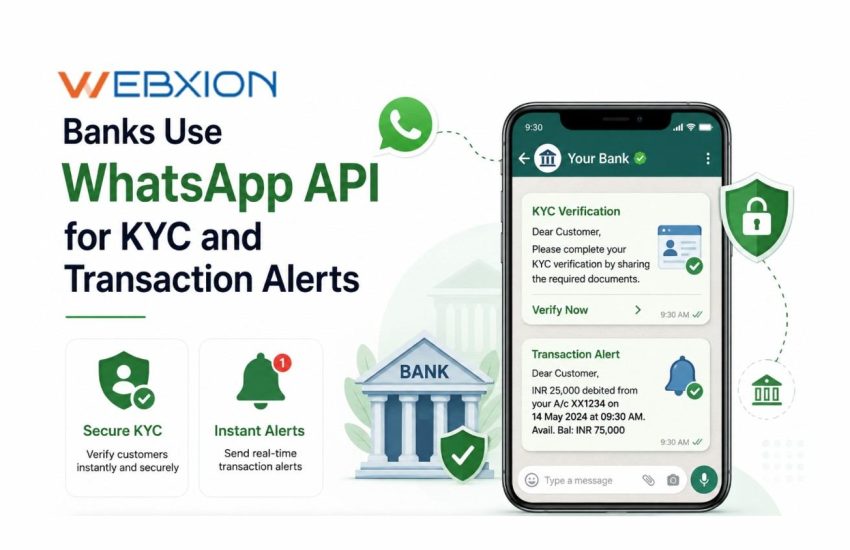
Summary – Banks use the WhatsApp Business API to send KYC reminders, verification updates, transaction alerts, fraud notifications, account-opening updates, and customer service messages. By integrating WhatsApp with banking and CRM systems, financial institutions can automate timely communication while improving customer convenience, engagement, and operational efficiency.
Banking customers no longer want to wait for an email or visit a branch just to check whether their KYC is complete or a transaction has gone through. They expect important updates to reach them quickly, clearly, and through channels they already use.
This is where the WhatsApp Business API has become useful for banks and financial institutions.
Instead of using WhatsApp simply as a customer support inbox, banks can connect the API with their backend systems and automate specific customer communications. A KYC reminder can be triggered when verification is pending. A transaction alert can be sent immediately after an eligible banking event. A service update can reach the customer without requiring manual intervention from a support executive.
For banks operating across India, this can be particularly valuable because customers are highly mobile-first and often prefer receiving service notifications on familiar communication platforms.
Why Are Banks Using WhatsApp API for Customer Communication?
The biggest reason is simple: customers are more likely to notice a message on a platform they already use regularly.
Traditional channels such as SMS and email remain important in banking. However, WhatsApp can provide a richer communication experience, particularly when a message requires a customer to take an action.
For example, consider a customer whose KYC update is pending.
Instead of receiving a short message saying, “Your KYC is pending,” a bank can use an approved WhatsApp message to explain the next step and direct the customer to the appropriate secure process.
Banks can use WhatsApp API communication for:
- KYC reminders and status updates
- Account-opening notifications
- Transaction alerts
- Payment confirmations
- Card-related notifications
- Loan and EMI reminders
- Fraud and security notifications
- Customer service conversations
- Application status updates
The important point is that WhatsApp API works as part of a bank’s communication infrastructure. It does not have to replace every existing channel.
What Is WhatsApp Business API for Banks?
The WhatsApp Business API, commonly associated with the WhatsApp Business Platform, allows businesses to connect WhatsApp communication with software systems.
For a bank, this could mean connecting WhatsApp with its CRM, customer-support platform, notification engine, or other approved banking workflows.
A simplified process looks like this:
Banking System → API/Communication Platform → WhatsApp Business Platform → Customer
When a predefined event occurs, the relevant system can trigger an approved customer message.
For example:
Transaction completed → Notification triggered → WhatsApp message sent → Customer receives alert
Similarly:
KYC pending → Reminder triggered → Customer receives WhatsApp notification → Customer follows secure verification process
This automation reduces the need for employees to manually send routine notifications.
How Do Banks Use WhatsApp API for KYC?
KYC, or Know Your Customer, is an important part of banking operations. Banks need customers to provide and maintain required information and documents according to applicable regulatory processes.
WhatsApp can support the communication around KYC without necessarily replacing the bank’s formal verification process.
1. KYC Reminder Notifications
Banks can send reminders when customers need to complete or update their KYC.
A useful notification should clearly explain:
- Why is the customer receiving the message?
- What action is required?
- Where should the customer complete the process?
- What happens next?
For example, instead of a vague reminder, a bank could send a concise notification explaining that the customer’s KYC update is pending and provide a secure, approved route to continue.
2. KYC Status Updates
Customers often want to know what happened after submitting their information.
WhatsApp notifications can communicate stages such as:
- KYC request received
- Verification in progress
- Additional information required
- Verification completed
- Application or update status changed
This reduces repetitive “What is my KYC status?” calls to customer support.
3. KYC and Customer Onboarding
WhatsApp can also support communication during account onboarding.
A customer may receive updates after starting an application, including instructions for the next step, document-related information, or confirmation that an application has moved forward.
The actual verification should continue through the bank’s authorized and secure processes.
4. KYC Renewal Reminders
For applicable customer records, banks can use automated notifications to remind customers when an update is required.
This is particularly useful for banks serving customers across multiple cities and regions, including Mumbai, Pune, Delhi, Bengaluru, Hyderabad, Chennai, Ahmedabad, and other Indian markets.
How Do Banks Use WhatsApp API for Transaction Alerts?
Transaction alerts are another major use case.
Customers want immediate confirmation when money moves in or out of their accounts. A timely notification can also help customers identify transactions they do not recognize.
Depending on the bank’s systems and communication policies, WhatsApp can support notifications related to:
- Debit transactions
- Credit transactions
- UPI payments
- Card transactions
- ATM withdrawals
- NEFT or RTGS-related updates
- Payment confirmations
- Failed transactions
- Loan or EMI payments
- Service requests
For instance, after an eligible transaction, the bank’s notification system can trigger a WhatsApp message containing the relevant transaction information.
The message should contain only the information appropriate for the communication and should direct customers to secure banking channels when additional authentication or sensitive action is required.
Can WhatsApp API Help Banks Prevent Fraud?
Yes, as a communication layer, WhatsApp can support faster fraud awareness.
Suppose a customer notices an unfamiliar card transaction several minutes after it occurs. A timely notification gives the customer an opportunity to recognize the transaction and follow the bank’s official process for reporting or securing the account.
Banks can use communication workflows for:
- Suspicious activity notifications
- Unauthorized transaction alerts
- Card security notifications
- Account-security updates
- Customer confirmation workflows
- Instructions for reporting suspicious activity
However, WhatsApp notifications should not be treated as a replacement for authentication, fraud detection, transaction monitoring, or other banking security controls.
The strongest approach is to connect communication with the bank’s existing security infrastructure.
WhatsApp API vs SMS for Banking Alerts: Which Is Better?
Both channels have an important role.
|
Feature |
WhatsApp API |
SMS |
|
Rich messaging |
Yes |
Limited |
|
Interactive buttons |
Supported where applicable |
No |
|
Two-way communication |
Yes |
Limited |
|
Transaction alerts |
Suitable |
Suitable |
|
KYC communication |
Highly useful |
Useful |
|
Media/document support |
Available where appropriate |
Very limited |
|
Automation |
Yes |
Yes |
|
Backup channel |
Can complement SMS |
Widely used |
The better strategy for many banks is not necessarily WhatsApp versus SMS.
It is WhatsApp plus SMS plus other communication channels, depending on the customer’s consent, message type, urgency, and operational requirements.
For critical notifications, banks may maintain multiple communication routes so that customers are not dependent on one platform.
How Can Banks Automate WhatsApp KYC and Transaction Alerts?
Automation is where WhatsApp API becomes significantly more valuable for large financial institutions.
A typical workflow can follow these steps:
- A banking event occurs
A customer makes a transaction or reaches a KYC-related milestone. - The banking system identifies the event
The notification engine determines which communication should be triggered. - The API sends the request
The bank’s integrated communication platform sends the relevant request. - An approved message is delivered
The customer receives the appropriate WhatsApp notification. - Delivery and engagement are tracked
The organization can monitor message status and operational performance. - Further action is triggered when appropriate
For example, a customer response may initiate a support workflow.
This approach can reduce repetitive manual work and make customer communication more consistent.
What Are the Benefits of WhatsApp API for Banks?
When implemented correctly, WhatsApp API can provide several practical benefits.
Faster customer communication
Automated alerts can reach customers soon after relevant events occur.
Better KYC follow-ups
Customers can receive timely reminders instead of relying entirely on branch visits or phone calls.
Reduced support workload
Routine status queries can be handled through automated notifications and conversational workflows.
Improved customer experience
Customers receive relevant information through a familiar communication channel.
Scalable communication
A properly integrated platform can support communication at enterprise volumes without requiring employees to send messages manually.
Better visibility
Organizations can track communication status and identify operational gaps.
Is WhatsApp API Secure for Banking Communication?
Security should be a primary consideration when implementing WhatsApp for banking communication.
Banks should establish clear controls around:
- API authentication
- System access permissions
- Customer consent
- Data handling
- Message content
- Secure links
- Customer verification
- Audit trails
- Fraud monitoring
- Internal access controls
Banks should also avoid unnecessarily exposing sensitive financial information in messages.
If a customer needs to perform a sensitive action, the WhatsApp message can guide them toward the bank’s official secure environment rather than asking them to share confidential credentials in a chat.
What Compliance Considerations Should Indian Banks Know?
For banks in India, WhatsApp communication needs to fit within the organization’s broader regulatory, privacy, security, and customer-consent framework.
Banks should consider applicable requirements and policies involving:
- RBI-regulated banking operations
- Customer consent
- Data protection and privacy
- Applicable banking security controls
- WhatsApp/Meta business messaging policies
- Approved message templates
- Record-keeping and audit requirements
- Secure authentication processes
For SMS communication, banks may also need to consider India’s telecom and DLT-related requirements where applicable.
The key principle is straightforward: using WhatsApp does not remove a bank’s existing compliance responsibilities.
How Can Banks Choose the Right WhatsApp API Provider?
Choosing the technology provider matters because banking communication requires reliability, security, scalability, and integration capability.
A bank or financial institution should evaluate whether a WhatsApp API Provider offers.
- Official WhatsApp Business Platform access
- Secure API infrastructure
- Enterprise scalability
- CRM and API integration
- Template management
- Delivery reporting
- Automation capabilities
- Customer support
- Reliable uptime
- Compliance-oriented implementation
- Omnichannel communication options
A provider should also understand banking workflows rather than simply offering a messaging API.
What Is the Future of WhatsApp Banking Communication?
WhatsApp banking is moving beyond simple notifications.
The next stage involves conversational banking, where customers can receive information, ask routine questions, and navigate approved service workflows through automated conversations.
AI-powered chatbots can potentially help with frequently asked questions, application status, service information, and customer-support routing.
For example, instead of calling customer support to ask, “What is the status of my application?”, a customer could initiate an approved WhatsApp conversation and receive the relevant status information.
This creates a broader communication ecosystem combining:
WhatsApp API + SMS + Voice + AI Chatbots + CRM + Banking Systems
For banks, the objective should not simply be sending more messages. It should be delivering the right message, to the right customer, at the right moment, through the right channel.
Make Banking Communication Faster with the Right CPaaS Partner
WhatsApp API can help banks make KYC updates, transaction alerts, customer support, and security notifications faster and more convenient. But a strong banking communication strategy should not depend on WhatsApp alone. Banks can combine it with an RCS Service Provider, Transactional SMS Service, OTP SMS Service, SMS Notification Service, Voice OTP Delivery Services, Outbound Voice Calls services, Missed Call Services, and AI Chatbot Software to create a connected customer experience.
For larger communication requirements, services such as Promotional Voice Calls Service, Bulk Voice Calling Service, Transactional Voice Calls Reseller, SMPP Server Service, Bulk SMS Reseller Services, Toll-free number provider, and DLT Registration support can help businesses build scalable communication workflows. Banks can also explore AI Voice Bot Services for automated customer interactions.
If you’re planning to build a secure, scalable, and omnichannel communication strategy for banking customers, Connect with WebXion to explore WhatsApp, SMS, RCS, voice, and AI-powered communication solutions designed around your business requirements.
Frequently Asked Questions About WhatsApp API for Banks
Can banks use WhatsApp API for KYC verification?
Yes. Banks can use WhatsApp API to communicate KYC reminders, status updates, instructions, and onboarding information. The actual verification process should follow the bank’s approved and applicable KYC procedures.
How do banks send transaction alerts on WhatsApp?
A bank can integrate its notification or banking systems with the WhatsApp Business Platform through an appropriate API solution. When an eligible transaction event occurs, the system can trigger an approved WhatsApp notification.
Is WhatsApp API secure for banking notifications?
WhatsApp API can be used as part of a secure banking communication strategy, but banks must implement appropriate authentication, data protection, access control, privacy, and security measures.
Can WhatsApp replace SMS transaction alerts?
Not necessarily. SMS remains an important banking communication channel. Many organizations can use WhatsApp alongside SMS and other channels depending on the communication requirement.
Can customers submit KYC documents through WhatsApp?
This depends on the bank’s approved workflow, technology, security controls, and applicable requirements. Banks should use secure and authorized processes for handling sensitive customer information.
Can WhatsApp API integrate with banking systems?
Yes. Through APIs and middleware, WhatsApp communication can be integrated with appropriate CRM, notification, customer-service, and banking technology systems.