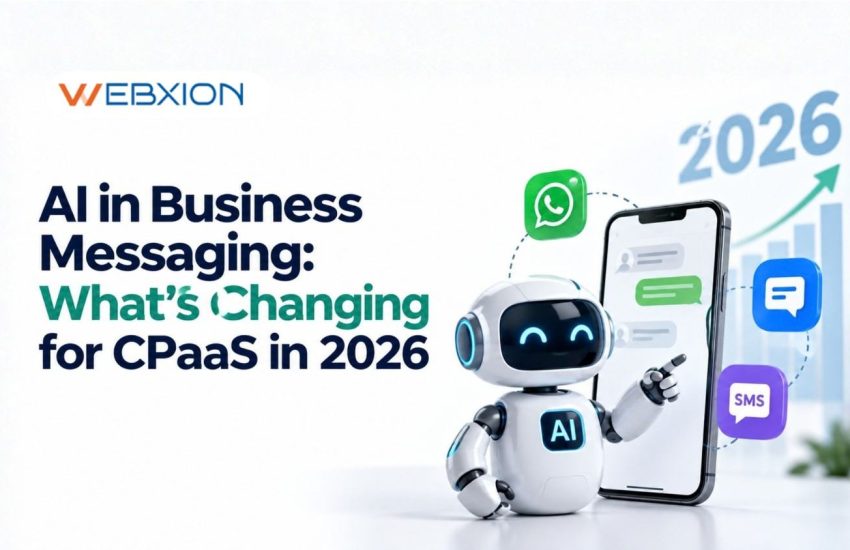
Summary – AI is changing CPaaS from a communication-delivery layer into an intelligent customer-engagement platform. Instead of simply sending an SMS, WhatsApp message, RCS notification or voice call, AI-powered CPaaS can understand customer intent, personalize conversations, select the right channel, automate responses and trigger business actions. In 2026, the strongest business messaging strategies are increasingly combining AI agents, WhatsApp Business API, RCS Business Messaging, SMS, voice AI, chatbots and CRM automation.
For years, CPaaS primarily answered one question: How can a business send messages reliably at scale?
That question still matters.
But businesses now want to know something more useful:
What should happen after the customer receives the message?
A customer may receive an order notification on WhatsApp, ask a follow-up question, request a delivery change, speak to an AI voice agent and eventually complete a payment—all within the same customer journey.
That is where AI is changing CPaaS.
Gartner’s 2026 research describes CPaaS as part of the move toward omnichannel human-AI communications, while its customer-service research identifies GenAI chatbots, voicebots, agentic AI platforms and CPaaS among technologies expected to deliver significant future value.
What Is AI in Business Messaging?
AI in business messaging means using artificial intelligence to understand, automate and improve customer conversations across communication channels.
Traditional messaging looks like this:
Business → Message → Customer
AI-powered business messaging can look more like:
Customer → AI understands intent → CPaaS selects channel → Business system checks data → AI responds → Action is completed
For example, imagine a customer messaging an online retailer:
“Where is my order, and can I change the delivery address?”
A basic SMS platform can send an order-status notification.
An AI-powered CPaaS platform can understand the request, connect with the order-management system, retrieve delivery information, explain the status and potentially route the address-change request to the appropriate workflow.
The difference is important.
CPaaS is moving from message delivery toward intelligent communication orchestration.
Why Is AI Becoming Important for CPaaS in 2026?
Customer expectations are changing from receiving information to completing tasks through conversations.
Gartner reported in August 2026 that 58% of customers who use GenAI have used it to complete a task, rather than simply obtain an answer. The research also found that 87% of customers believe businesses using GenAI for customer service should provide access to a human agent.
This creates a clear requirement for modern CPaaS platforms:
AI should automate useful work, not simply generate replies.
For Indian businesses, the opportunity is particularly relevant because messaging is already deeply integrated into customer journeys.
Meta introduced Business AI on WhatsApp for eligible small businesses in India, supporting capabilities such as 24/7 responses, product recommendations, lead capture and appointment booking. The feature also supports India’s native languages and allows businesses to take over conversations when human intervention is required.
This is an important signal for the wider CPaaS market.
How Is AI Changing Traditional CPaaS?
Traditional CPaaS provides APIs and infrastructure for programmable communications.
Businesses can connect:
- SMS APIs
- WhatsApp Business Platform
- RCS Business Messaging
- Voice APIs
- OTP services
- IVR
- Missed call systems
- Contact-center workflows
AI adds an intelligence layer above these communication channels.
Instead of deciding manually which message to send, when to send it and how to respond, businesses can build workflows where AI helps interpret customer behavior and select the next action.
A simple example:
Customer clicks an RCS product card → asks a question → AI answers → customer requests a callback → voice workflow triggers → CRM records the interaction.
That is more than messaging.
It is conversational customer engagement.
What Are the Biggest AI Trends in Business Messaging?
1. AI Agents Are Moving Beyond Basic Chatbots
Traditional chatbots generally answer predefined questions.
AI agents are designed to understand context and perform tasks.
For example, instead of saying:
“Your appointment is available.”
An AI agent could help the customer select a suitable time, confirm details, update the CRM and send a confirmation message.
This shift from answering to acting is one of the most important developments in AI-powered CPaaS.
2. Conversational Messaging Is Replacing One-Way Communication
Businesses have traditionally used SMS and messaging for announcements:
“Your order has shipped.”
The next stage is conversational:
“Your order has shipped. Would you like to track it?”
The customer can respond immediately.
For e-commerce, banking, education, healthcare, travel and real estate, this creates opportunities to turn notifications into useful customer journeys.
3. WhatsApp and RCS Are Becoming AI-Friendly Experience Channels
India is an important market for conversational messaging.
Infobip’s 2026 India messaging report reported 70% growth in RCS interactions and 20% growth in WhatsApp usage in its analyzed messaging data, highlighting the movement toward richer, conversational customer engagement.
WhatsApp can support conversations, media, product information and customer support.
RCS can add branded rich messaging, suggested actions, product cards and interactive experiences where supported.
AI can sit behind both channels to help businesses interpret customer responses and automate the next step.
4. AI Voice Is Becoming Part of CPaaS
Text is not always the best communication format.
Consider a customer who receives an appointment reminder but does not respond.
An AI voice workflow could make an outbound call, identify the customer’s intent, confirm the appointment and escalate the call to a human when necessary.
This creates a broader CPaaS ecosystem involving:
- AI voice bots
- Outbound Voice Calls
- Voice OTP Delivery Services
- IVR
- Missed Call Services
- Call routing
- Human-agent escalation
Businesses can also combine conversational AI with CPaaS to connect AI chatbots and voice bots with WhatsApp, SMS, RCS and voice channels. This allows an AI assistant to move beyond answering questions and become part of a connected customer communication workflow. For a deeper look at how this integration works, see CPaaS and AI bots.
The result is not “AI replacing voice.”
It is AI making voice workflows more responsive and automated.
How Does AI Work Inside a Modern CPaaS Platform?
A practical architecture looks like this:
Customer → WhatsApp/RCS/SMS/Voice → AI Layer → CPaaS Orchestration → CRM/ERP → Business Action → Customer
The AI layer can help determine:
- What the customer wants?
- Which information is relevant?
- Which communication channel should be used?
- Whether automation is appropriate?
- When should a human take over?
- What action should happen next?
For example, a customer in Mumbai may enquire about a property through WhatsApp.
The AI assistant can answer questions about availability, capture the customer’s preferred budget and location, qualify the lead and schedule a callback.
The CRM receives the lead information.
The sales team receives a qualified enquiry instead of an unstructured chat.
That is where AI delivers practical CPaaS value.
How Can Businesses Use AI-Powered Messaging?
E-commerce
AI can assist with:
- Product recommendations
- Order tracking
- Abandoned-cart conversations
- Delivery questions
- Returns
- Customer support
- Promotional campaigns
Banking and Fintech
AI-enabled messaging can support:
- Transaction notifications
- Customer queries
- Loan enquiries
- Account-related assistance
- Fraud-alert workflows
- OTP communication
- Human escalation
Sensitive financial workflows still require appropriate security, authentication and compliance controls.
Education
Coaching institutes, colleges and edtech companies can use conversational messaging for:
- Course enquiries
- Admission counselling
- Fee reminders
- Application updates
- Demo-class bookings
- Student support
For example, an education business in Pune can use WhatsApp to answer course questions while automatically capturing the student’s preferred program and callback requirement.
Healthcare
AI-assisted communication can support appointment enquiries, reminders, FAQs and follow-up workflows.
Healthcare organizations should apply additional controls around personal and sensitive information rather than allowing an AI system to make unsupported clinical decisions.
Real Estate
Real estate businesses can use AI to qualify leads based on:
- Location
- Budget
- Property type
- Purchase timeline
- Preferred configuration
A lead generated through WhatsApp or RCS can then be pushed into the CRM for sales follow-up.
What Role Does AI Play in WhatsApp Business Messaging?
WhatsApp is increasingly becoming more than a notification channel.
A modern WhatsApp Business API strategy can combine:
Messaging + AI Chatbot + CRM + Automation + Human Support
For example:
Customer: “Do you have a 2BHK under ₹80 lakh in Wakad?”
AI: Checks connected property information.
AI: Shares suitable options.
Customer: “Can I visit this weekend?”
AI: Collects preferred time.
System: Creates a CRM activity.
Sales team: Takes over when required.
This type of workflow is especially useful for Indian businesses where customers frequently prefer conversational interactions over traditional forms.
What About AI, SMS and RCS?
SMS remains important for high-reach communication, especially for OTPs, transactional notifications and time-sensitive alerts.
AI does not necessarily replace SMS.
Instead, AI can help determine when SMS is appropriate and when another channel can provide a richer experience.
A business might use:
SMS → RCS → WhatsApp → Voice
depending on customer availability, consent, use case and workflow requirements.
This is where omnichannel messaging becomes valuable.
Instead of treating every channel separately, businesses can manage customer communication as one connected journey.
What Are the Benefits of AI-Powered CPaaS?
Businesses adopting AI within CPaaS can potentially improve:
- Response speed
- Customer engagement
- Lead qualification
- Personalization
- Support automation
- Operational efficiency
- Communication consistency
- CRM data capture
- Cross-channel orchestration
- Customer experience
But the objective should not be “use AI everywhere.”
The better question is:
Where can AI remove friction from a customer journey?
That approach produces more measurable results.
What Challenges Should Businesses Consider?
AI-powered messaging also introduces new responsibilities.
Data Privacy
Businesses need appropriate controls around customer information, API access and data handling.
AI Accuracy
AI should not confidently invent product details, prices, policies or commitments.
Human Escalation
Customers should have a clear path to human assistance when AI cannot resolve the issue. Gartner’s 2026 research specifically highlights the importance customers place on human-agent access.
Compliance
Businesses still need to consider applicable messaging, consent, privacy and telecom requirements.
AI does not remove regulatory obligations.
Integration Complexity
The value of AI depends heavily on integration with CRM, ERP, inventory, support and other business systems.
A chatbot disconnected from business data can answer questions, but it may struggle to complete meaningful tasks.
How Should You Choose an AI-Powered CPaaS Provider?
Do not evaluate a CPaaS provider only on message pricing.
Look at the complete communication stack.
Ask whether the provider supports:
- WhatsApp Business API Provider
- RCS Business Messaging services
- SMPP Server Service
- SMS Notification services
- OTP services
- transactional SMS services
- Outbound Voice Calls services
- Missed Call Services
- AI ChatBots services
- AI Voice Bot Services
- Bulk voice calling service
- IVR Calls Services
- CRM integration
- Automation and workflow orchestration
- Analytics and delivery reporting
- Human-agent escalation
For Indian businesses, local operational knowledge also matters.
A provider supporting businesses across Mumbai, Pune, Bengaluru, Delhi, Hyderabad and Tier-2 and Tier-3 markets should understand that customer communication is not identical across every industry or region.
Language preferences, customer expectations, campaign timing and channel behavior can vary significantly.
What Will CPaaS Look Like After AI Adoption?
The future of CPaaS is unlikely to be a single channel.
It is more likely to be an intelligent communication layer connecting customers, businesses and multiple channels.
The evolution can be simplified as:
Traditional CPaaS:
Send → Deliver → Track
Modern AI-powered CPaaS:
Understand → Decide → Respond → Act → Learn
That distinction matters.
The competitive advantage will increasingly come from what a business can accomplish inside the conversation, not simply how many messages it can send.
2026 Checklist for Businesses Adopting AI in Messaging
Before implementing AI-powered business messaging, ask:
- What customer problem are we solving?
- Which conversations should be automated?
- Which conversations require humans?
- Is our CRM connected?
- Do we need WhatsApp, RCS, SMS, voice or multiple channels?
- Can AI access accurate business information?
- How will customer consent be managed?
- What happens when AI cannot answer?
- How will performance be measured?
- Can the workflow scale across regions and languages?
Start with one high-value customer journey rather than attempting to automate everything at once.
Build an AI-Ready Business Messaging Strategy With WebXion
AI is changing what businesses expect from CPaaS. The focus is moving from simply delivering a message to understanding the customer, choosing the right communication channel and helping complete the next business action.
For businesses in India, that means combining the right mix of WhatsApp Business API, RCS Business Messaging, SMS API, SMPP Server Service, Outbound Voice Calls, Missed Call Services, AI ChatBots and AI Voice Bots with CRM and workflow automation.
WebXion can help businesses build and manage these communication workflows across customer acquisition, notifications, support, lead qualification and engagement.
If you are planning to add AI to your business messaging strategy, connect with WebXion to discuss your use case, channels and automation requirements and build a CPaaS setup designed around measurable customer journeys rather than disconnected messages.
Frequently Asked Questions
What is AI in business messaging?
AI in business messaging uses artificial intelligence to understand customer intent, personalize communication, automate conversations and trigger business actions across channels such as WhatsApp, RCS, SMS and voice.
How is AI changing CPaaS?
AI is shifting CPaaS from basic message delivery toward intelligent communication orchestration, where AI can understand conversations, select workflows, personalize responses and connect messaging with CRM and business systems.
Can AI work with WhatsApp Business API?
Yes. Businesses can combine WhatsApp Business API capabilities with AI chatbots, CRM integrations, automation and human-agent support to create conversational customer journeys.
Is SMS still relevant with AI?
Yes. SMS remains useful for OTPs, transactional notifications, alerts and situations where broad reach is important. AI can complement SMS rather than replace it.
Will AI replace human customer support?
AI can automate repetitive interactions, but many situations still require human assistance. Effective customer-service designs should provide escalation paths when AI cannot appropriately resolve an issue.