Summary – An AI chatbot is a software system that uses artificial intelligence—primarily natural language processing (NLP) and machine learning (ML)—to understand customer messages and respond in a human-like, context-aware way. For businesses, AI chatbots automate customer support, sales conversations, lead qualification, and operational queries across channels like websites, WhatsApp, SMS, and apps. Unlike traditional rule-based bots, AI chatbots learn from interactions, improve over time, and deliver faster, more personalized experiences at scale.
Customers today expect fast, accurate, and consistent responses—whether they are browsing a website, messaging on WhatsApp, or following up after a purchase. For businesses, meeting these expectations at scale is no longer possible with human teams alone. This is where AI chatbots have become a practical, results-driven solution.
AI chatbots are not experimental tools anymore. They are actively used by businesses to handle customer support, qualify leads, assist sales, automate repetitive queries, and improve response times across digital channels. From startups to large enterprises, organizations are using AI chatbots to reduce costs, increase efficiency, and deliver better customer experiences without compromising personalization.
This guide explains what an AI chatbot is, how it works in real business environments, and how companies across industries are using it to drive measurable growth. The focus is practical, experience-led, and designed to help decision-makers understand whether AI chatbots are the right fit for their business goals.
Why Are Businesses Rapidly Adopting AI Chatbots?
Customer expectations have changed. People now expect instant responses, accurate answers, and seamless conversations—regardless of time, channel, or location.
From real deployments across Indian, Middle Eastern, and global markets, one pattern is clear: businesses that delay conversational automation struggle with response times, support costs, and lead leakage. AI chatbots solve these issues by acting as a first line of intelligent engagement, not just a support tool.
What Is an AI Chatbot?
An AI chatbot is a conversational system designed to:
- Understand user intent in natural language
- Interpret context, not just keywords
- Respond intelligently using trained data and real-time logic
- Improve accuracy through continuous learning
For businesses, this means conversations move from static scripts to adaptive, intent-driven dialogue that feels natural to customers.
How Does an AI Chatbot Work?
1. How does an AI chatbot understand customer messages?
The chatbot receives a user message via a channel (website chat, WhatsApp, RCS, SMS, app).
It uses Natural Language Processing (NLP) to break down the message—identifying words, phrases, tone, and meaning.
Example:
“Where is my order?” and “Track my shipment” trigger the same intent.
2. How does intent recognition work?
The chatbot matches the message to a predefined intent (order tracking, pricing, support request) using trained datasets and ML models.
Over time, the chatbot improves intent accuracy by learning from:
- Past conversations
- Corrections
- Escalations to human agents
3. How does the chatbot decide the right response?
Once intent is identified, the chatbot:
- Pulls data from CRMs, ERPs, or order systems
- Applies business rules (eligibility, region, timing)
- Generates a response using structured logic or generative AI
This ensures answers are relevant, compliant, and accurate.
4. How does machine learning improve chatbot performance?
Machine learning allows the chatbot to:
- Learn new phrasing patterns
- Reduce fallback responses
- Improve personalization
- Adapt to regional language usage ( Hinglish, regional English, local slang )
What Are the Different Types of AI Chatbots Businesses Use?
Rule-Based Chatbots
- Fixed flows
- Low flexibility
- Suitable for simple FAQs
AI-Powered Chatbots
- NLP + ML driven
- Handle varied customer queries
- Adapt over time
Hybrid Chatbots
- Combine rules for compliance with AI for flexibility
- Common in banking, telecom, and regulated industries
Generative AI Chatbots
- Use large language models
- Handle complex conversations
- Best for sales assistance and knowledge discovery
How Are Businesses Actually Using AI Chatbots? (Real Use Cases)
Customer Support Automation
- Order status, refunds, account updates
- First-response handling before human escalation
Lead Generation & Qualification
- Asking qualifying questions
- Routing hot leads to sales teams
- Capturing intent 24/7
Sales & Product Discovery
- Recommending products
- Explaining plans or pricing
- Upselling based on behavior
Appointment Scheduling
- Clinics, service providers, consultants
- Reduces no-shows through reminders
Internal Operations
- HR queries
- IT ticket triage
- Employee onboarding
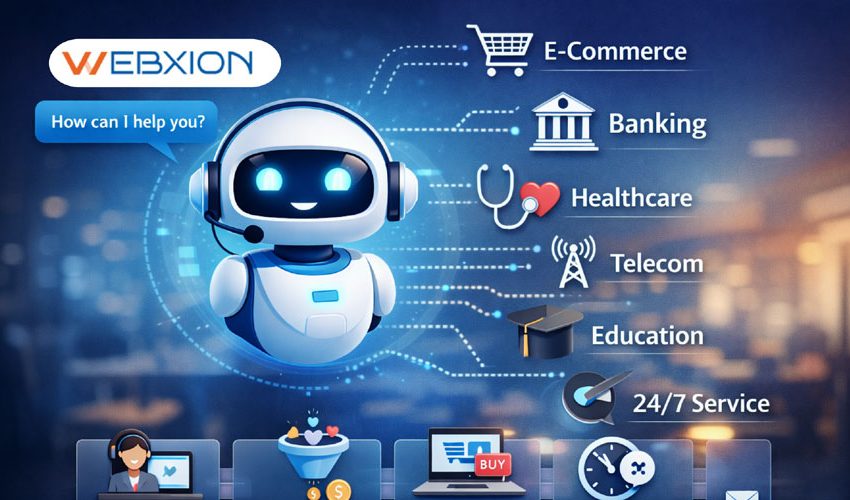
Which Industries Benefit Most from AI Chatbots?
E-commerce & Retail
Faster order tracking, cart recovery, and post-purchase support.
Banking & Financial Services
Balance checks, service requests, lead capture—while maintaining compliance.
Healthcare
Appointment booking, follow-ups, and patient education without overloading staff.
Telecom
High-volume query handling for plans, billing, and service issues.
Education
Admissions queries, course discovery, and student support.
How AI Chatbots Improve Customer Experience (CX)?
AI chatbots improve CX by:
- Responding instantly, even during peak hours
- Maintaining conversation context across channels
- Offering consistent, error-free information
- Reducing customer frustration caused by long wait times
In local markets like India, multilingual and regional understanding significantly improves engagement and trust.
Are AI Chatbots Secure and Compliant?
Modern AI chatbot platforms support:
- Data encryption
- Role-based access
- GDPR and regional compliance
- Secure API integrations
For regulated industries, hybrid models ensure sensitive actions remain controlled.
Common Challenges Businesses Face (and How to Avoid Them)
- Poor training data → Start with real customer queries
- Over-automation → Always include human fallback
- Low intent accuracy → Continuous retraining is essential
- Disconnected systems → Integrate CRM and support tools early
How Should Businesses Choose the Right AI Chatbot?
Ask these questions:
- What conversations do we want to automate first?
- Does the chatbot support our primary channels?
- Can it handle local language and regional behavior?
- Are analytics and conversation insights available?
- How easily can it scale as volume grows?
How Do Businesses Measure AI Chatbot ROI?
Key metrics include:
- Ticket deflection rate
- First-response time
- Cost per conversation
- Lead conversion improvement
- Customer satisfaction (CSAT)
Most businesses recover chatbot investment within 3–6 months when deployed strategically.
Ready to Put AI Chatbots to Work for Your Business?
If your business manages high-volume customer interactions—or is preparing to scale—now is the time to move beyond basic automation. With the right conversational strategy, you can engage customers instantly, reduce response delays, and drive measurable growth across every touchpoint.
With WebXion, you gain access to WhatsApp Business Platform services, RCS Business Messaging services, SMS Notification Service services, Outbound Voice Calls services, Missed Call Services services,—designed to deliver verified, seamless, and high-impact customer journeys across the channels your audience trusts most.
👉 Contact WebXion today to design a unified messaging and AI-driven communication strategy tailored to your business goals, customer behavior, and long-term growth roadmap.
Frequently Asked Questions
-
Can AI chatbots replace human customer support agents?
AI chatbots are designed to support and augment human agents, not replace them entirely. They handle repetitive, high-volume queries such as order status, FAQs, appointment booking, and basic troubleshooting. This allows human agents to focus on complex issues, emotional conversations, and high-value interactions that require judgment and empathy. In real business environments, AI chatbots typically reduce 30–60% of incoming support tickets, improving efficiency while keeping humans in the loop through seamless escalation and handover.
-
Are AI chatbots suitable for small and medium-sized businesses?
Yes, AI chatbots are highly suitable for small businesses and SMEs, especially those with limited support teams. They help small businesses offer 24/7 customer support, faster response times, and consistent communication—capabilities traditionally associated with larger enterprises. Modern chatbot platforms are scalable and cost-efficient, allowing small businesses to start with basic use cases like FAQs or lead capture and gradually expand into sales automation, WhatsApp chatbots, and CRM integrations as they grow.
-
How long does it take to implement an AI chatbot for a business?
Implementation timelines depend on the complexity of use cases and integrations. Basic AI chatbot deployments (FAQs, lead capture, appointment booking) can go live in 2–4 weeks Advanced chatbots with CRM, payment systems, or multilingual support may take 4–8 weeks or longer Businesses that start with clearly defined goals and real customer data typically achieve faster, more accurate chatbot performance from day one.
-
Do AI chatbots work on WhatsApp, SMS, and other messaging channels?
Yes, AI chatbots work across WhatsApp Business, SMS, RCS, websites, mobile apps, and social messaging platforms when deployed through official business messaging APIs. This enables omnichannel customer engagement, allowing users to start a conversation on one channel and continue on another without losing context. For regions like India, where WhatsApp usage is dominant, this significantly improves reach, response rates, and customer satisfaction.