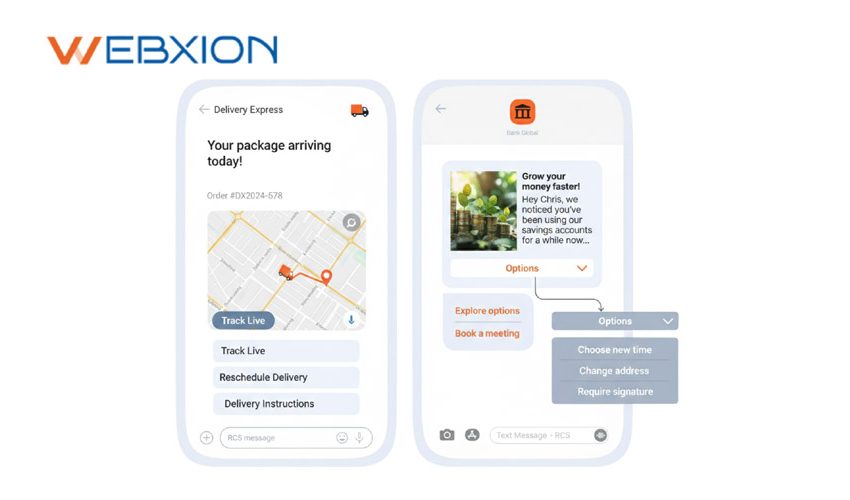
Summary – RCS (Rich Communication Services) Business Messaging enables brands to engage customers through verified, branded, and interactive messages delivered directly to the native messaging inbox on Android devices. Unlike traditional SMS, RCS supports rich media, carousels, suggested reply buttons, read receipts, analytics, and two-way conversations, resulting in higher open rates, stronger customer trust, improved experience, and better conversions. For mobile-first markets like India, RCS is rapidly becoming a high-impact customer engagement channel across retail, BFSI, education, healthcare, travel, and service-based industries.
Customer engagement has shifted decisively to mobile messaging, but traditional channels like SMS are struggling to keep pace with rising user expectations. Customers now expect recognizable brands, richer content, instant actions, and secure communication—not plain-text messages from unknown numbers.
This is where RCS Business Messaging steps in. Built as the next evolution of SMS, RCS enables businesses to deliver branded, interactive, and conversational experiences directly inside the native messaging inbox. For mobile-first markets like India, where Android usage dominates and messaging is a primary communication channel, RCS is quickly becoming a powerful tool for driving attention, trust, and conversions.
In this article, we break down the top 10 benefits of RCS Business Messaging for customer engagement, supported by real-world examples, practical insights, and industry-specific use cases to help businesses understand why RCS is no longer optional—but strategic.
What Is RCS Business Messaging?
RCS Business Messaging is the next evolution of SMS. It combines the reach and familiarity of text messaging with the interactivity of modern chat apps, without requiring users to install any additional application.
Messages are delivered through the default Android Messages app, supported by mobile network operators and the Android ecosystem led by Google.
From the customer’s perspective, RCS messages feel native, secure, and intuitive. From a business perspective, RCS unlocks branding, interactivity, analytics, and conversational engagement—capabilities that traditional SMS cannot provide.
Why Customer Engagement Needs RCS in 2026?
Customer engagement is no longer about sending more messages. It is about sending relevant, trustworthy, and action-oriented communication.
Consumers are increasingly cautious about SMS due to spam, phishing, and generic promotional blasts. At the same time, they expect faster responses, richer information, and smoother experiences on mobile.
RCS bridges this gap by offering visual clarity instead of long text, verified branding instead of unknown numbers, and guided actions instead of passive notifications.
In markets like India, where Android dominates smartphone usage, RCS provides a strong alternative to OTT platforms such as WhatsApp, which require app installs and explicit opt-ins.
Top 10 Benefits of RCS Business Messaging for Customer Engagement
1. Rich Media Messaging That Captures Attention
RCS allows brands to send high-resolution images, videos, GIFs, and interactive carousels directly within the message.
Visual communication reduces cognitive effort. Customers understand product value instantly without scrolling through dense text.
Real-world example:
An Indian D2C fashion brand uses a three-card carousel to showcase new arrivals, each with a “View Product” CTA. Engagement and click-through rates increase substantially compared to text-only SMS.
Actionable insight:
Replace long promotional copy with one visual asset and one primary CTA.
2. Verified Business Profiles Build Instant Trust
RCS messages come from verified business profiles displaying the brand name, logo, and official branding.
Trust is critical in mobile messaging, especially in regions with high SMS fraud. Verified branding reassures users that the message is authentic.
Industry experience:
Banks, fintech companies, and insurance providers see immediate improvements in open rates after switching to verified RCS messaging.
Actionable insight:
Complete brand verification early and maintain consistent brand visuals across all templates.
3. Higher Open and Read Rates Than Traditional SMS
RCS consistently outperforms SMS in terms of open and read rates.
This happens because branded senders reduce skepticism, rich previews attract attention, and messages feel legitimate rather than promotional spam.
Customers do not just read RCS messages—they interact with them.
Actionable insight:
Use a benefit-led first line combined with a visual preview to maximize opens.
4. Interactive CTAs and Quick Reply Buttons Reduce Friction
RCS supports one-tap CTAs and suggested replies, such as Buy Now, Book Appointment, Track Order, or Call Support.
Each tap removes steps from the customer journey, making action effortless.
Real-world example:
A healthcare provider allows patients to confirm or reschedule appointments directly inside the message, reducing no-shows and operational load.
Actionable insight:
Limit CTAs to two or three focused actions to avoid decision paralysis.
5. Two-Way Conversational Messaging Improves Engagement
RCS enables real-time, two-way conversations, turning broadcasts into meaningful interactions.
Customers can reply, ask questions, or request assistance within the same thread, increasing confidence and response quality.
Industry use case:
Educational institutions use RCS for admission queries, enabling counselors to respond faster and qualify leads more effectively.
Actionable insight:
Deploy chatbots for common queries and escalate high-intent conversations to human agents.
6. Advanced Analytics and Read Receipts Enable Optimization
RCS provides delivery status, read receipts, button clicks, and interaction data.
This transforms messaging into a measurable performance channel rather than a blind broadcast.
Marketing teams can refine creatives, CTAs, and timing based on real user behavior.
Actionable insight:
Review engagement metrics weekly and optimize messages based on click and read data.
7. Personalization at Scale Drives Relevance
RCS integrates with CRM and automation tools to deliver personalized messaging at scale, using customer name, city, behavior, or purchase history.
Local relevance:
Retail brands can run city-specific campaigns for Mumbai, Pune, Bengaluru, or Delhi, aligning offers with regional demand.
Actionable insight:
Personalize greetings and CTAs while keeping message structure consistent.
8. No App Download Required Improves Customer Experience
RCS works directly inside the default messaging app, removing friction associated with app installs.
This is ideal for first-time interactions, transactional updates, and re-engagement campaigns.
Strategic insight:
Use RCS as the first engagement layer, then transition users to apps or OTT channels when deeper interaction is needed.
9. Better Conversion Rates and Stronger ROI
RCS supports the entire customer funnel—from awareness to conversion and retention.
Higher engagement naturally leads to improved conversion rates and better ROI compared to SMS-only campaigns.
Industry insight:
E-commerce and BFSI brands report stronger lead-to-conversion ratios after adopting RCS.
Actionable insight:
Create separate RCS flows for awareness, conversion, and post-purchase communication.
10. Secure, Spam-Resistant, and Future-Ready Messaging
RCS includes sender verification, brand authentication, and carrier-level security, reducing phishing and spam.
This protects customers while safeguarding brand reputation.
With AI-powered chat, automation, and deeper integrations on the roadmap, RCS is positioned as a long-term messaging standard.
Actionable insight:
Maintain message relevance and frequency caps to protect sender reputation.
Industry-Specific Use Cases of RCS Business Messaging
Retail and eCommerce brands use RCS for product launches, abandoned cart reminders, and order tracking.
Banking and financial services rely on RCS for KYC reminders, alerts, and service requests.
Education and EdTech institutions use it for admissions communication and counseling.
Healthcare providers send appointment confirmations and instructions.
Travel and hospitality brands share itineraries, alerts, and upgrade offers.
RCS vs SMS vs OTT Messaging Apps
SMS offers universal reach but limited engagement.
RCS delivers rich, branded, interactive experiences on Android devices.
OTT apps provide deep functionality but require opt-ins and app installs.
Best practice: Use RCS as the primary rich messaging channel with SMS fallback for unsupported devices.
How RCS Improves the Customer Journey
RCS builds awareness through visual, branded messages.
It supports consideration with interactive content and quick replies.
It accelerates conversion through one-tap CTAs.
Post-purchase updates and support strengthen retention and loyalty.
Your Messaging Should Do More Than Deliver — It Should Drive Action.
With WebXion’s WhatsApp Business Platform services, RCS Business Messaging services, SMS Notification Service services, Outbound Voice Calls services, Missed Call Services, and AI ChatBots services, your brand shows up verified, interactive, and impossible to ignore inside the native inbox. From rich media to instant CTAs, RCS turns routine messages into experiences that build trust and move customers to act.
Contact WebXion today to design RCS journeys tailored to your industry, region, and business goals. Our team helps you plan, launch, and optimize RCS campaigns that convert attention into measurable results.
Frequently Asked Questions
-
Is RCS Business Messaging better than SMS?
Yes. RCS delivers significantly higher engagement through rich media, branding, and interactivity.
-
Does RCS work on iPhones?
Currently, RCS primarily supports Android devices. SMS fallback ensures coverage.
-
Is RCS secure for customers and businesses?
Yes. Verified sender IDs and carrier controls greatly reduce fraud and spam.
-
Who should use RCS Business Messaging?
Any brand targeting Android users that wants higher engagement, trust, and measurable ROI.