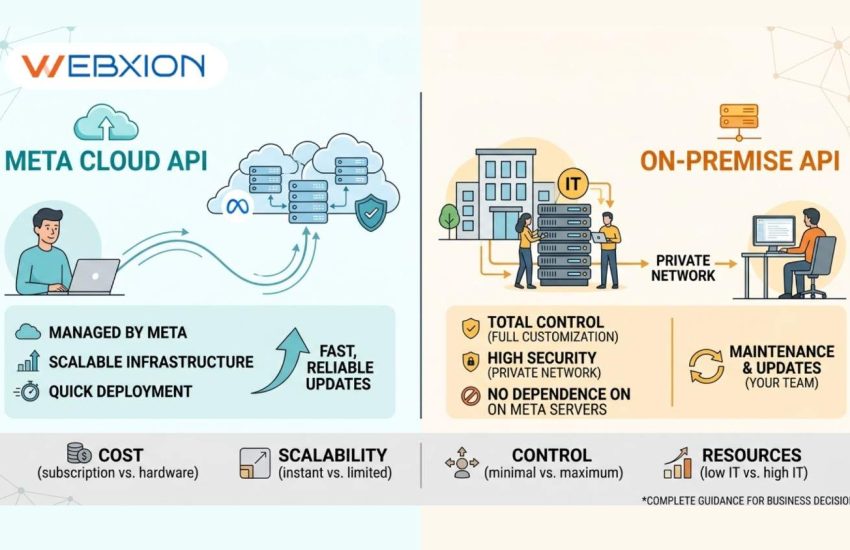
Summary – Businesses adopting the WhatsApp Business Platform often need to choose between Meta Cloud API and On-Premise API to power their customer communication and messaging automation. Both options allow companies to integrate the WhatsApp Business API for sending notifications, managing customer support, and automating conversations at scale.
The Meta Cloud API, hosted by Meta Platforms, is a cloud-based solution that removes the need for businesses to manage servers or infrastructure. It offers faster deployment, automatic scalability, and easier integration, making it ideal for startups, e-commerce brands, and growing businesses that want to launch WhatsApp messaging quickly.
The On-Premise API, on the other hand, is hosted on a company’s own servers. This gives organizations greater control over infrastructure, security policies, and system configurations. It is typically preferred by large enterprises or industries that require strict compliance and internal data governance.
Quick comparison
Meta Cloud API
- Hosted on Meta’s cloud
- Faster setup and integration
- No server maintenance required
On-Premise API
- Hosted on company infrastructure
- Greater control over systems and security
- Requires dedicated technical resources
For businesses across India, including companies in Mumbai, Delhi, and Bengaluru, the right choice depends on scalability needs, technical capabilities, and long-term messaging strategy.
Messaging apps have become one of the most effective ways for businesses to connect with customers, and WhatsApp is leading this shift in digital communication. With billions of active users, companies now rely on WhatsApp to manage customer support, send order updates, run marketing campaigns, and automate conversations.
To enable large-scale communication, businesses use the WhatsApp Business Platform, which allows integration of chatbots, CRM systems, and automated messaging through the WhatsApp Business API. However, when implementing the API, organizations must decide between two deployment options: Meta Cloud API or On-Premise API.
The choice depends on how your business manages infrastructure, security, and scalability. A growing e-commerce company may prefer the speed and simplicity of a cloud-based setup, while large enterprises may require deeper control over servers and data management.
Understanding the difference between these two API models helps businesses choose the right solution for customer engagement, messaging automation, and scalable communication strategies.
What Is WhatsApp Business Platform?
The WhatsApp Business Platform is Meta’s enterprise messaging infrastructure that enables businesses to communicate with customers at scale using automation, integrations, and advanced messaging capabilities. Unlike the standard WhatsApp Business app designed for small teams, the platform supports large-scale operations and integration with existing business systems.
Organizations across industries—including retail, fintech, healthcare, travel, and education—use the platform to manage customer communication through automated messaging and conversational interfaces.
Key capabilities of the WhatsApp Business Platform include:
- Automated customer support and chatbots
- Transactional notifications and alerts
- Order updates and delivery tracking
- Marketing campaigns and promotional messages
- Two-way customer communication
Businesses commonly integrate WhatsApp messaging with:
- CRM platforms
- Customer support software
- E-commerce systems
- Marketing automation tools
- AI chatbot platforms
Core components within the WhatsApp ecosystem include:
WhatsApp Business App
- Designed for small businesses
- Manual messaging
- Limited automation
WhatsApp Business API
- Built for medium and large businesses
- Supports automation and integrations
- Enables scalable messaging
Meta Cloud API
- Hosted by Meta
- Simplified deployment
On-Premise API
- Hosted on business servers
- Full infrastructure control
This platform enables companies to deliver real-time, personalized, and scalable customer engagement experiences.
What Is Meta Cloud API?
The Meta Cloud API is the latest and most streamlined way to access the WhatsApp Business Platform. Instead of hosting servers or managing infrastructure, businesses can directly connect to Meta’s cloud-hosted environment through APIs.
This approach significantly reduces the complexity of deploying WhatsApp messaging systems while maintaining enterprise-level reliability and scalability.
Businesses using the Meta Cloud API benefit from faster deployment and minimal maintenance because Meta manages the backend infrastructure.
Key features of Meta Cloud API include:
- Hosted entirely on Meta’s cloud infrastructure
- No server setup or maintenance required
- Automatic scalability for high message volumes
- Faster onboarding and integration
- Built-in security and reliability
Practical advantages for businesses include:
Quick integration
- Developers can deploy messaging solutions faster
- Ideal for startups and SaaS companies
Reduced operational overhead
- No infrastructure monitoring
- No server maintenance costs
High availability
- Meta handles uptime, redundancy, and performance
Seamless scaling
- Supports increasing customer messaging volume
Real-world example:
An Indian e-commerce brand launching a festive sale campaign during Diwali may need to send thousands of order confirmations and delivery updates. Using the Meta Cloud API, the company can scale messaging instantly without provisioning additional servers.
What Is WhatsApp On-Premise API?
The On-Premise API is the original deployment method for the WhatsApp Business Platform. In this model, businesses host the API on their own servers or infrastructure, giving them complete control over the messaging environment.
While this approach provides greater flexibility and customization, it also requires dedicated technical resources to manage deployment, maintenance, updates, and performance monitoring.
Companies with strong IT infrastructure or strict compliance policies often prefer the On-Premise API.
Key features include:
- Hosted on company-owned servers
- Full control over system architecture
- Greater flexibility in infrastructure management
- Custom integration capabilities
Benefits for enterprises include:
Advanced customization
- Businesses can tailor server configurations
- Custom security policies can be applied
Infrastructure control
- Internal IT teams manage the environment
- Suitable for organizations with existing server architecture
Compliance flexibility
- Allows compliance with strict data policies
- Useful for financial institutions and regulated sectors
However, this option also involves:
- Server maintenance
- Infrastructure costs
- Monitoring and scaling responsibilities
- Technical team management
Large organizations in sectors such as banking, telecom, and insurance often choose this model because it aligns with their internal IT governance and compliance frameworks.
Meta Cloud API vs On-Premise API: Key Differences
Understanding the differences between Meta Cloud API and On-Premise API helps businesses determine which infrastructure model best suits their operational requirements.
The most significant distinction lies in hosting and infrastructure management. With the Cloud API, Meta manages the backend environment, whereas the On-Premise API requires businesses to manage their own servers.
Major differences include:
Hosting
- Meta Cloud API
- Hosted by Meta
- No infrastructure management required
- On-Premise API
- Hosted on company servers
- Requires IT infrastructure management
Deployment speed
- Cloud API
- Faster implementation
- Quick onboarding
- On-Premise API
- Longer deployment timeline
- Infrastructure configuration required
Maintenance
- Cloud API
- Managed by Meta
- Automatic updates
- On-Premise API
- Managed internally
- Requires technical teams
Scalability
- Cloud API
- Automatic scaling
- Ideal for growing businesses
- On-Premise API
- Manual scaling
- Infrastructure expansion required
These differences often influence the decision between ease of use versus infrastructure control.
Pros and Cons of Meta Cloud API
The Meta Cloud API has become the preferred choice for many businesses because it simplifies the deployment of WhatsApp messaging solutions.
Advantages include:
Fast implementation
- Businesses can integrate WhatsApp messaging quickly
- Developers spend less time configuring infrastructure
Lower operational complexity
- No server management required
- Reduced IT workload
Scalability
- Handles high message volumes automatically
- Ideal for marketing campaigns and notifications
Cost efficiency
- Eliminates infrastructure setup costs
However, there are also some considerations:
- Limited infrastructure customization
- Dependency on Meta’s hosting environment
- Less control over backend configurations
For most small and medium businesses, these trade-offs are acceptable because the benefits of simplicity and scalability outweigh the limitations.
Pros and Cons of On-Premise API
The On-Premise API provides greater infrastructure control but requires additional technical expertise and resources to maintain.
Advantages include:
Full infrastructure ownership
- Businesses control servers and hosting environments
- Ideal for organizations with strict IT policies
Advanced customization
- Custom deployment architecture
- Flexible server configurations
Security flexibility
- Businesses can implement internal security protocols
- Suitable for highly regulated industries
Limitations include:
- Higher setup and operational costs
- Ongoing infrastructure maintenance
- Longer deployment timelines
- Requirement for dedicated DevOps teams
Because of these factors, On-Premise API deployments are typically used by large enterprises with existing infrastructure capabilities.
Which Businesses Should Choose Meta Cloud API?
The Meta Cloud API is particularly beneficial for organizations that want to implement WhatsApp messaging quickly without managing complex infrastructure.
Businesses that benefit the most include:
Startups
- Limited IT resources
- Need quick market deployment
E-commerce platforms
- Order confirmations
- Delivery notifications
SaaS companies
- Customer support automation
- Onboarding notifications
Digital marketing agencies
- Campaign messaging
- customer engagement automation
Advantages for these businesses include:
- Faster product launches
- Simplified messaging integration
- Reduced operational costs
- Improved scalability during marketing campaigns
Many companies across India’s digital startup ecosystem prefer Cloud API because it allows them to focus on customer engagement instead of infrastructure management.
Which Businesses Should Choose On-Premise API?
The On-Premise API is better suited for enterprises that require deep control over infrastructure and data management.
Industries that often prefer this option include:
- Banking and financial services
- Government organizations
- Large telecom companies
- Insurance providers
These businesses often require:
- Strict compliance with internal security policies
- Dedicated data governance frameworks
- Custom deployment environments
Key benefits for enterprises include:
- Greater infrastructure control
- Advanced security configurations
- Integration with legacy systems
- Flexible server architecture
However, these benefits come with the requirement for experienced IT teams and infrastructure investments.
Cost Comparison: Cloud API vs On-Premise API
Cost considerations play a major role when choosing between Meta Cloud API and On-Premise API.
The Cloud API typically offers lower upfront costs because businesses do not need to purchase or maintain servers.
Key cost factors include:
Meta Cloud API
- No infrastructure setup cost
- No server maintenance expenses
- Lower operational overhead
- Pay primarily for messaging usage
On-Premise API
- Server infrastructure investment
- Maintenance and monitoring costs
- Technical team salaries
- Scaling infrastructure expenses
For most growing businesses, the Cloud API offers a more predictable and cost-efficient deployment model.
Security and Compliance Considerations
Security and compliance are critical when deploying messaging platforms that handle sensitive customer information.
Meta provides robust security features across both API models, but the responsibility distribution differs.
Security advantages of Meta Cloud API:
- Infrastructure managed by Meta
- Automatic security updates
- High-availability architecture
Security advantages of On-Premise API:
- Full control over server configurations
- Custom security protocols
- Alignment with enterprise compliance requirements
Businesses must evaluate their data protection policies, regulatory requirements, and internal governance frameworks before choosing a deployment method.
Transform Your Customer Communication with Advanced Messaging Solutions
Choosing between Meta Cloud API and On-Premise API depends on your business needs, infrastructure, and scalability goals when implementing the WhatsApp Business Platform. While many businesses prefer the simplicity and speed of cloud-based deployment, enterprises that require greater infrastructure control may choose on-premise solutions.
Beyond selecting the right API, businesses also need powerful communication tools to automate conversations and improve customer engagement.
With Webxion, you can access a complete suite of messaging solutions, including:
- WhatsApp Business Platform services for automated customer communication
- RCS Business Messaging services for rich and interactive messaging experiences
- SMS Notification services for alerts, OTPs, and transactional updates
- Outbound Voice Calls services for automated voice communication
- Missed Call Services for lead generation and customer engagement
- AI ChatBots services to automate conversations and provide 24/7 customer support
If you’re planning to scale your customer communication and automate engagement, connect with Webxion to explore the right messaging solutions for your business.
Frequently Asked Questions
1. What is the difference between Meta Cloud API and On-Premise API?
The main difference is where the WhatsApp infrastructure is hosted.
The Meta Cloud API is hosted by Meta Platforms, so businesses don’t need to manage servers or infrastructure. This makes it faster to deploy and easier to scale when using the WhatsApp Business API.
The On-Premise API runs on your company’s own servers. It provides more control over infrastructure and security but requires technical resources to manage and maintain.
Quick overview
- Meta Cloud API
- Hosted by Meta
- Faster setup
- No infrastructure management
- On-Premise API
- Hosted on company servers
- Greater system control
- Requires technical maintenance
2. Is Meta Cloud API better for businesses?
For most businesses, yes. The Meta Cloud API simplifies the deployment of the WhatsApp Business Platform because Meta manages the infrastructure.
Key benefits include:
- Faster WhatsApp API integration
- Automatic scalability for messaging
- No server maintenance
- Lower operational complexity
However, enterprises with strict compliance requirements may still prefer the On-Premise API.
3. Which businesses should use WhatsApp Cloud API?
The WhatsApp Cloud API is ideal for businesses that want to launch automated messaging and customer engagement quickly.
Common use cases include:
- E-commerce order notifications
- Customer support automation
- WhatsApp marketing campaigns
- Customer engagement messaging
Companies in cities like Mumbai, Delhi, and Bengaluru widely use Cloud API to scale digital customer communication.
4. Is the On-Premise WhatsApp API still supported?
Yes, the On-Premise API is still supported within the WhatsApp Business Platform.
It is commonly used by large organizations that require:
- Custom infrastructure control
- Advanced security policies
- Integration with internal systems
Industries like banking, telecom, and insurance often prefer this deployment model.
5. How do businesses choose the right WhatsApp API?
Choosing the right WhatsApp Business API deployment depends on your business needs.
Consider these factors:
- Infrastructure resources
- Security requirements
- Messaging scale
- Implementation speed
Most growing companies choose Meta Cloud API for faster deployment and scalability, while large enterprises may choose On-Premise for greater infrastructure control.