
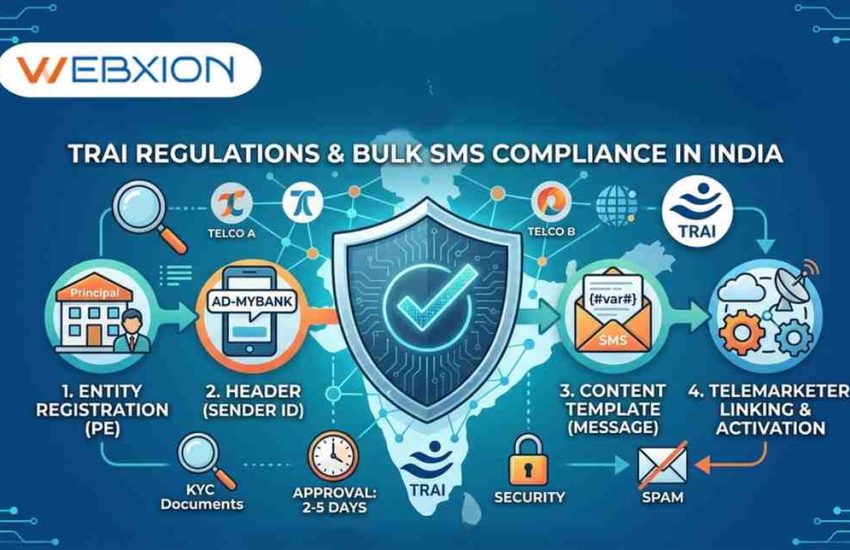
Summary – DLT Registration in India is a mandatory compliance process introduced by the Telecom Regulatory Authority of India (TRAI) to regulate business SMS communication and reduce spam messages. It uses Distributed Ledger Technology (DLT) to verify businesses that send bulk SMS, OTP messages, transactional alerts, promotional campaigns, and customer notification services.
Under TRAI regulations, companies must register as a Principal Entity, approve their sender IDs (headers), and submit SMS templates before sending messages through telecom networks. This system helps telecom operators authenticate message sources, improve SMS delivery rates, and protect customers from fraudulent communications.
For businesses using SMS gateway services, OTP verification systems, or bulk messaging platforms, DLT registration is essential to ensure legal compliance, secure messaging, and reliable message delivery across India.
If your business sends OTP verification codes, transaction alerts, delivery updates, appointment reminders, or promotional SMS campaigns, understanding DLT registration is essential for operating in India.
To control spam and fraudulent SMS activity, the Telecom Regulatory Authority of India implemented the DLT framework, which requires businesses to verify their identity, register sender IDs, and approve message templates before sending SMS messages.
This system creates a secure and transparent messaging ecosystem, ensuring that customers receive communications only from verified organizations. As a result, businesses benefit from higher SMS delivery rates, better customer trust, and full telecom compliance when running bulk messaging or notification services.
Understanding DLT Registration in India
DLT registration has become one of the most important compliance requirements for businesses that communicate with customers through SMS. Over the last decade, SMS messaging has remained one of the most reliable channels for delivering real-time information such as OTP verification, transaction alerts, appointment reminders, order updates, delivery notifications, and promotional campaigns.
However, before TRAI introduced the DLT framework, the telecom ecosystem faced a serious challenge—mass spam messaging and fraudulent SMS activities. Consumers frequently received unsolicited promotional messages, phishing attempts, and misleading offers from unverified senders.
To address these issues, TRAI implemented the DLT-based messaging ecosystem, creating a transparent and traceable communication system.
The primary goals of DLT regulations include
- Eliminating spam and fraudulent SMS communication
- Protecting consumer privacy and preferences
- Improving transparency in commercial messaging
- Establishing accountability for businesses sending SMS
- Creating a secure telecom messaging infrastructure
Today, all businesses that use bulk SMS gateways, SMS marketing platforms, messaging APIs, CRM integrations, or notification systems must register on a DLT platform before sending messages.
Without DLT compliance, telecom operators will automatically block SMS traffic from unregistered sources.
What is Distributed Ledger Technology (DLT) in Telecom Messaging?
Distributed Ledger Technology is a decentralized database system that records transactions across multiple nodes in a secure and transparent manner. Each transaction is stored permanently and cannot be altered without network consensus.
In telecom messaging, DLT acts as a secure registry for SMS communications.
Every message sent through the telecom network is validated against the DLT ledger to confirm:
- Sender identity
- Message template approval
- Content category
- Customer consent preferences
This ensures that only authorized businesses with approved templates and registered headers can send SMS messages.
Why DLT technology is effective for SMS regulation?
- Creates tamper-proof messaging records
- Prevents unauthorized message transmission
- Enables telecom operators to track communication sources
- Improves regulatory compliance enforcement
This technology plays a crucial role in reducing telecom fraud, phishing scams, and spam messaging.
Why TRAI Introduced DLT Regulations for SMS Communication?
The Telecom Regulatory Authority of India implemented DLT regulations as part of its Telecom Commercial Communication Customer Preference Regulation (TCCCPR) framework.
The regulation was introduced after telecom authorities observed a dramatic rise in unwanted commercial communications (UCC).
Common issues before DLT implementation
- Businesses sending bulk promotional SMS without consent
- Fraudulent banking or lottery messages
- Phishing attacks targeting mobile users
- Identity masking through fake sender IDs
DLT regulations created a centralized compliance framework that requires all businesses and telemarketers to verify their identity before sending messages.
This system dramatically reduced spam messaging across Indian telecom networks.
Who Needs DLT Registration in India?
DLT registration is required for any organization that sends SMS messages to customers for business purposes.
Businesses that must complete DLT registration include
- Banks and financial institutions
- Fintech platforms
- E-commerce companies
- Online marketplaces
- Logistics and courier companies
- Healthcare providers and hospitals
- Educational institutions
- Travel and hospitality brands
- Telecom service providers
- Insurance companies
- Real estate companies
- Retail brands and franchises
Even startups sending OTP authentication messages or transactional alerts must register on the DLT platform.
Example scenario
An online marketplace sends order confirmation messages after every purchase. These messages are considered transactional SMS, and therefore the business must register its entity, headers, and templates under DLT regulations before sending them.
Key Entities in the DLT Messaging Ecosystem
The DLT framework consists of several participants that play specific roles in the messaging process.
Principal Entity (PE)
A Principal Entity is the business or organization sending messages to customers.
Examples include:
- Banks sending payment alerts
- Online stores sending order updates
- Hospitals sending appointment reminders
Principal Entities must register their business identity and messaging purpose on the DLT platform.
Telemarketer
Telemarketers are organizations that send SMS messages on behalf of businesses.
They typically provide services such as:
- Bulk SMS gateway solutions
- Messaging APIs
- Campaign management software
- Automated SMS notifications
Telemarketers must also register on the DLT platform and obtain approval from telecom operators.
Sender Header (Sender ID)
A header is the alphanumeric sender name displayed in the recipient’s SMS inbox.
Examples:
- HDFCBK
- ICICIB
- AMZNSH
- FLIPKR
Headers help customers identify the sender and build trust in the communication.
Businesses must register each sender ID they intend to use.
SMS Templates
SMS templates define the content structure of messages sent to customers.
Templates include variable placeholders for dynamic information.
Example template
“Dear {CustomerName}, your order {OrderID} has been shipped and will be delivered by {DeliveryDate}.”
Templates must be approved before use to ensure compliance with messaging regulations.
Categories of SMS Messages Under DLT Regulations
TRAI classifies SMS communications into multiple categories.
Understanding these categories helps businesses submit the correct template type.
Transactional SMS
Transactional messages contain critical information related to customer activity.
Examples include:
- OTP verification codes
- Payment confirmations
- Bank transaction alerts
- Password reset messages
These messages are allowed even for users registered under Do Not Disturb (DND) preferences.
Service SMS
Service messages provide non-promotional information related to customer services.
Examples include
- Appointment reminders
- Subscription notifications
- Service updates
- Account activity alerts
Promotional SMS
Promotional messages are marketing communications used to advertise products or services.
Examples include
- Discount offers
- Festival sales announcements
- Product launch promotions
- Seasonal marketing campaigns
These messages can only be sent to customers who have opted in to receive promotional communications.
Complete Step-by-Step DLT Registration Process in India
Businesses must follow a structured process to become DLT compliant.
Step 1: Select a TRAI-approved DLT platform
Companies must register through telecom operator DLT portals such as
- Airtel DLT portal
- Vodafone Idea DLT portal
- Jio DLT platform
These portals connect to the centralized telecom messaging ecosystem.
Step 2: Register as a Principal Entity
Businesses must create an account and provide company information such as
- Organization name
- PAN number
- GST certificate
- Registered business address
- Authorized representative details
After submission, the platform reviews and verifies the information.
Step 3: Business verification and KYC approval
Telecom operators verify the authenticity of the company using submitted documents.
Verification ensures that the organization is legitimate and authorized to send commercial communications.
Step 4: Apply for Sender Header Registration
Businesses must submit requests for sender IDs.
Approval depends on
- Brand name verification
- Trademark validation
- Company identity matching
Once approved, headers can be used in SMS communications.
Step 5: Submit SMS Template Requests
Businesses must register message templates before sending SMS campaigns.
Templates must include
- Message category
- Communication purpose
- Variable placeholders
Templates undergo compliance review before approval.
Step 6: Link Telemarketers or SMS Providers
If a company uses a bulk SMS provider or messaging API, it must link the telemarketer account to its entity ID.
This allows messages to be sent through approved telecom routes.
Step 7: Start sending compliant SMS campaigns
After all approvals are completed, businesses can start sending SMS messages.
Messages must strictly follow approved templates and headers.
Documents Required for DLT Registration
Businesses must provide several documents during registration.
Common documents include
- PAN card of the organization
- GST registration certificate
- Certificate of incorporation
- Company address proof
- Authorized signatory ID proof
- Board resolution letter (sometimes required)
Accurate documentation speeds up the approval process.
Common Reasons SMS Templates Get Rejected
Template rejection is a frequent issue during DLT onboarding.
Common causes
- Promotional language in transactional templates
- Incorrect variable formatting
- Excessive use of symbols or punctuation
- Non-compliant message content
Tips to prevent rejection
- Use simple, clear language
- Follow telecom template guidelines
- Ensure variable placeholders are properly structured
Working with experienced SMS gateway providers can reduce rejection rates.
Major Benefits of DLT Registration for Businesses
Businesses that complete DLT registration experience several operational advantages.
Higher SMS delivery rates
Verified messages are prioritized by telecom operators.
Improved brand trust
Customers recognize approved sender IDs.
Regulatory compliance
Companies avoid penalties or SMS blocking.
Better campaign performance
Businesses can track delivery reports, open rates, and response rates.
Real-World Industry Examples of DLT Messaging
Banking sector
Banks send millions of transactional SMS messages daily including
- ATM withdrawal alerts
- OTP verification codes
- Credit card payment reminders
DLT ensures these messages are delivered securely.
E-commerce companies
Online retailers use SMS for
- Order confirmations
- Delivery updates
- Payment notifications
Reliable SMS delivery improves customer experience.
Healthcare services
Hospitals and clinics use SMS for
- Appointment reminders
- Diagnostic report alerts
- Prescription notifications
These messages require verified sender identities to maintain trust.
Best Practices for Maintaining DLT Compliance
Businesses should implement the following strategies.
Maintain updated template libraries
Regularly review templates to ensure compliance with telecom regulations.
Monitor delivery analytics
Analyze SMS performance to detect blocked messages.
Train marketing teams
Ensure teams understand the difference between transactional and promotional messaging.
Partner with experienced messaging providers
Reliable SMS gateway providers simplify compliance management.
Enhance Your Business Communication with Advanced Messaging Solutions
After completing DLT registration, businesses can expand their customer communication using multiple verified messaging channels. Combining different platforms helps improve engagement, message delivery, and overall customer experience.
You can strengthen your communication strategy with:
- WhatsApp Business Platform services for interactive customer conversations and support
- RCS Business Messaging services for rich media messaging and branded notifications
- SMS Notification services for OTPs, alerts, and transactional updates
- Outbound Voice Calls services for automated reminders and voice notifications
- Missed Call Services for lead generation and quick customer engagement
- AI ChatBots services for automated responses and 24/7 customer support
To implement reliable and DLT-compliant messaging solutions, connect with Webxion and streamline your business communication with secure, scalable, and high-delivery messaging services.
Frequently Asked Questions
1. What is DLT Registration in India and why is it mandatory for businesses?
DLT Registration is a telecom compliance process introduced by the Telecom Regulatory Authority of India (TRAI) to regulate commercial SMS communication and reduce spam messages across telecom networks. Businesses that send bulk SMS, OTP verification messages, transactional alerts, promotional SMS campaigns, and service notifications must register on a DLT platform before sending messages.
Key points to understand:
- It verifies businesses sending bulk SMS or automated SMS notifications
- Requires approval of sender IDs (headers) and SMS templates
- Ensures compliance with TRAI telecom messaging regulations
- Helps telecom operators prevent spam and fraudulent SMS activity
- Improves SMS delivery rates and customer trust
Without DLT registration, telecom operators may block SMS campaigns or OTP messages, affecting business communication.
2. Who needs to complete DLT registration in India?
Any organization that sends business SMS messages to customers must complete DLT registration. This applies to companies using SMS gateway providers, bulk SMS services, marketing automation tools, CRM messaging systems, or OTP authentication platforms.
Businesses that typically require DLT registration include:
- Banks and financial institutions sending transaction alerts and OTP SMS
- E-commerce platforms sending order confirmations and delivery updates
- Healthcare providers sending appointment reminders and service notifications
- Educational institutions sending student alerts and admission notifications
- Retail brands sending promotional SMS campaigns and discount offers
- Logistics companies sending shipment tracking and delivery alerts
Even startups or small businesses sending customer notification SMS must register on the DLT platform.
3. What documents are required for DLT registration?
Businesses must submit several documents when registering on a telecom operator DLT portal to verify their identity and business legitimacy.
Common documents required include:
- Company PAN card
- GST registration certificate
- Certificate of incorporation or business registration proof
- Authorized signatory ID proof
- Company address proof
- Business website or brand details (sometimes required)
Providing accurate documentation helps speed up the DLT verification process and reduces registration delays.
4. How long does the DLT registration and approval process take?
The DLT registration timeline depends on document verification, header approval, and SMS template approval. In most cases, businesses can complete the process within a few days.
Typical approval timeline:
- Principal Entity registration: 24–72 hours
- Sender ID (header) approval: 1–2 days
- SMS template approval: 1–3 days
- Telemarketer linking: Same day after approval
Businesses that work with experienced bulk SMS service providers or SMS gateway platforms can often complete the process faster.
5. What happens if a business sends SMS without DLT registration?
Sending commercial SMS without DLT compliance can lead to serious issues for businesses relying on SMS communication.
Possible consequences include:
- SMS messages being blocked by telecom operators
- Failed OTP delivery and transaction alerts
- Poor SMS campaign performance
- Violation of TRAI telecom messaging regulations
- Potential regulatory penalties or restrictions
To avoid these problems, businesses should complete DLT registration, sender ID approval, and SMS template verification before launching any bulk SMS or marketing campaigns.



?&media=https://www.webxion.com/wp-content/uploads/2026/03/What-is-DLT-Registration-A-Complete-Guide-to-TRAI-DLT-Regulations-and-the-DLT-Registration-Process-in-India-2026.jpeg)