DLT Mandatory for SMS & Voice Services
Distributed Ledger Technology (DLT) is a mandatory TRAI-regulated platform designed to curb spam, enhance transparency, and ensure secure message and voice communication in India.
Sender Verification
DLT verifies business identity and prevents misuse, ensuring only authenticated entities send SMS and voice campaigns.
Template Approval
DLT enforces mandatory template registration, ensuring compliant, spam-free, and consistent messaging across all telecom networks.
DLT Process
How to Apply for DLT ?
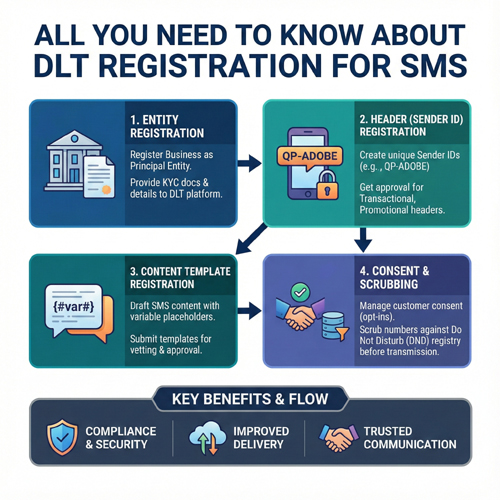
Entity Registration
You need to fulfill KYC (Know Your Customer) documents like GST, PAN etc. You need to provide these documents to get Enity ID Registration. Both Business or Individual will get a unique Entity ID.

Sender ID Registration
SMS are classified into Promotional or Transactional as Service Implicit / Service Explicit. All sms messages need to classified in above type only. Every header gets a unique Sender ID (Header ID).
Template Registration
Once SMS Template is created, the entity retains the template ownership across all platforms. Every template gets a unique Template ID that is shared across other Blockchain DLT SMS platforms seamlessly.

Get Instant DLT Registration
Have some questions in mind ?
Frequently Asked Questions
-
1. What is DLT and why is it important?
DLT (Distributed Ledger Technology) is a TRAI-regulated framework designed to validate sender identity, ensure template compliance, and eliminate spam across Indian telecom networks. All businesses sending Bulk SMS, Transactional Alerts, Promotional SMS, or using Voice/OBD/IVR services must register on DLT with approved headers, templates, and consent details.
-
3. Is DLT Registration mandatory ?
Yes. As per TRAI regulations, DLT registration is compulsory for all businesses before sending SMS in India. You must register Entity, Header, and Templates on DLT platforms.
To know more visit : DLT Registration Process -
5. Who must be on DLT?
All enterprises, financial institutions, startups, NGOs, and service providers using SMS, Voice, IVR, OBD, or API-based communication are required to register.
-
7. Why is Template Approval mandatory?
Operators will not process any SMS unless its content exactly matches an approved template. This ensures message consistency, regulatory compliance, and protection against misuse.
-
9. How long does it take to get approvals?
Typically, entity verification takes 24–48 hours, while Header and Template approvals may take 24–72 hours, depending on operator workload.
-
11. What happens if SMS are sent without DLT compliance?
Messages will be blocked at the operator gateway, resulting in 100% delivery failure and potential compliance penalties for repeated violations.
-
13. Do you help with DLT onboarding?
Yes. We assist in:
- Entity registration
- Header creation
- Template approval
- Content mapping
-
2. What is a Header (Sender ID)?
A Header is a unique 6-character alphanumeric ID representing your brand. It helps customers identify who the message is coming from and prevents spoofing. (e.g., WEBXON). Promotional SMS: Fixed numeric ID. Transactional SMS: Alphabetical Sender ID.
-
4. Why must businesses register on DLT?
DLT registration is mandatory for any entity sending Bulk SMS or Voice campaigns. It ensures only verified organizations can communicate with customers, significantly reducing fraudulent and unsolicited messages.
-
6. What role does the DLT platform play in SMS delivery?
DLT validates your Header, Template, and Consent before forwarding traffic to operators—ensuring compliant and verified communication.
-
8. What documents are needed for DLT onboarding?
A registered entity must provide:
- Certificate of Incorporation or GST
- PAN
- Authorized Signatory ID
- Letter of Authorization (if required)
This ensures legitimacy before enabling messaging privileges. -
10. Is there a fee for DLT registration?
Most operators charge a one-time registration fee along with annual renewal. These charges are standard across the ecosystem.
-
12. Does Voice calling also require DLT compliance?
Absolutely. For OBD, IVR, or Call Patch campaigns, Caller IDs and voice scripts must be registered and aligned with DLT norms.
-
14. Can one DLT registration work across all telecom operators?
Yes. Once your Entity ID is approved on one platform, it is synchronized across all other operators, simplifying multi-operator messaging.
-
15. How often must DLT details be renewed?
Most operator platforms require annual renewal. Entities must maintain updated documents to avoid service disruption.
-
16. Does WebXion provide DLT assistance?
Yes. With extensive telecom domain expertise, WebXion offers end-to-end DLT support—covering documentation, entity setup, Header creation, Template approvals, and regulatory guidance—to ensure clients remain fully compliant.
DLT Operators List
Choose DLT Operator from below list
Join over +5,000 happy Clients