Summary – RCS Business Messaging is worth considering for Indian brands that want to deliver interactive promotions, showcase products, and create branded customer experiences. However, SMS remains a reliable choice for OTPs, transactional alerts, and messages that need broad mobile compatibility. For many businesses, the best strategy is to combine RCS with SMS fallback, choosing the channel according to customer reach, campaign objectives, cost, and measurable results.
Indian businesses use messaging every day to send order confirmations, payment reminders, OTPs, promotional offers, and appointment updates. But as customer expectations change, traditional text messages may not always provide the visual experience brands want.
This raises an important question: should Indian businesses invest in RCS messaging, or is SMS still enough to reach customers and generate conversions?
The answer depends on what you want your messages to achieve. A short banking alert has different requirements from an e-commerce promotion featuring product images, discounts, and shopping buttons. Understanding these differences can help your business choose the right messaging solution without increasing communication costs unnecessarily.
What Is RCS Messaging, and How Is It Different From SMS?
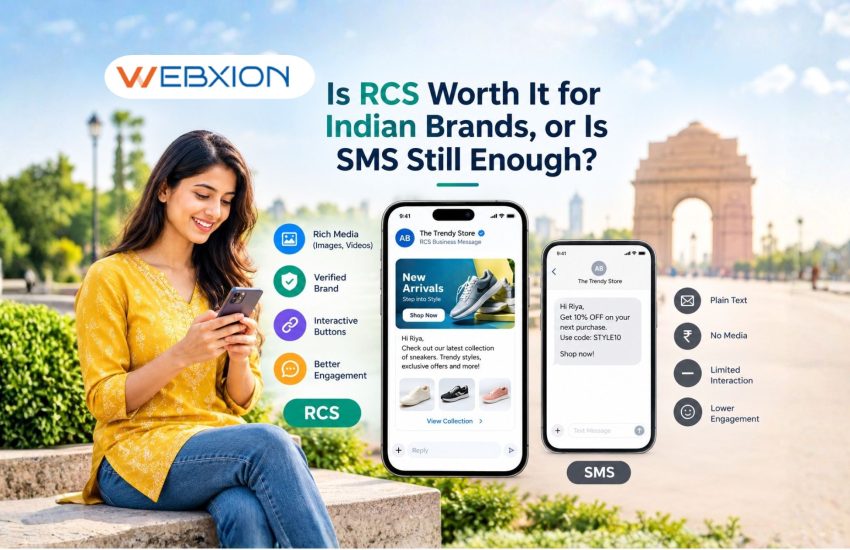
RCS stands for Rich Communication Services. RCS Business Messaging allows businesses to send interactive messages through compatible messaging applications, with features such as branded business profiles, images, rich cards, suggested replies, and clickable action buttons.
SMS, or Short Message Service, delivers text messages directly to mobile phones without requiring mobile internet access to receive the message.
The main difference is that SMS focuses on straightforward communication, while RCS can turn a message into an interactive customer experience.
For example, an SMS from an online retailer might say, “Explore our festive collection: [website link].” An RCS message could display product images, prices, promotional details, and a button to explore the collection.
Both approaches can be useful. The right choice depends on whether the additional interaction provides enough value to justify the cost.
What features make RCS different from SMS?
RCS Business Messaging can support:
- Verified business profiles: Display a business name, logo, and other approved brand information.
- Rich media: Share images, videos, and product cards where supported.
- Interactive buttons: Encourage customers to shop, book an appointment, call, or visit a website.
- Two-way conversations: Allow customers to respond through supported suggested replies and conversational workflows.
- Engagement reporting: Track supported delivery, read, and interaction events.
SMS remains effective for short messages, verification codes, and simple notifications. It can also include links, although the experience is generally less interactive.
RCS vs SMS in India: Which Is Better for Your Business?
Neither channel is universally better. The decision depends on compatibility, customer expectations, campaign design, and cost.
Factor | RCS Business Messaging | SMS |
Content | Rich media and interactive elements | Primarily text and links |
Branding | Rich business profile where supported | Registered sender identification under applicable rules |
Internet access | Requires compatible RCS connectivity | Does not require mobile data to receive SMS |
Device reach | Depends on device, app, and network support | Broad compatibility across mobile phones |
Customer interaction | Supports interactive actions and replies | Primarily text-based, with links or other response mechanisms |
Reporting | Can provide read and interaction events | Reporting varies by provider and delivery route |
Best use cases | Product discovery, interactive offers, guided journeys | OTPs, alerts, confirmations, and simple reminders |
For an Indian retailer running a visual festive campaign, RCS may help customers explore products without immediately leaving the messaging interface. For a business sending thousands of straightforward payment reminders, SMS may be the more practical option.
The important question is not which technology is newer. It is which channel makes each customer interaction easier and more effective.
Is RCS Business Messaging Available and Practical in India?
RCS is a practical option for eligible Indian audiences, but businesses should not assume every customer can receive an RCS message.
Availability depends on device compatibility, the messaging application, RCS settings, network support, and the applicable business messaging route. Reach can also differ across customer segments and locations.
Before launching an RCS campaign, check:
- How many customers in your target audience are RCS-capable.
- Whether the selected messaging provider supports your intended audience and use case.
- Whether your brand profile and messaging agent require approval.
- Whether promotional messaging limits or other platform policies apply.
- How messages will be handled when RCS is unavailable.
This is especially important for businesses targeting customers across metropolitan areas such as Pune, Mumbai, Bengaluru, and Delhi, as well as smaller cities and rural markets. Do not assume that location alone determines RCS compatibility; measure eligibility within your actual customer database.
For India-specific campaigns, also confirm the applicable promotional messaging rules before estimating reach or planning high-volume sends.
RCS vs SMS Cost in India: Which Delivers Better ROI?
RCS messaging costs depend on the provider, messaging category, campaign setup, and applicable commercial terms. Businesses can also compare Bulk SMS pricing in India to understand how message volume, message type, and delivery requirements affect their communication budget.
Therefore, there is no universal rule that RCS is always more expensive or that SMS always produces better returns.
Instead, compare the complete campaign cost, including integration, creative development, messaging charges, reporting, and any fallback traffic.
Consider this illustrative example.
An Indian e-commerce business spends ₹10,000 on an SMS campaign and generates 50 purchases. Its campaign cost per purchase is ₹200. If a comparable RCS campaign costs ₹12,000 and generates 80 purchases, its cost per purchase is ₹150.
These figures are hypothetical, not industry benchmarks. They demonstrate why campaign outcomes matter more than message price alone.
Use this formula to evaluate performance:
Cost per conversion = Total campaign cost ÷ Number of conversions
Before shifting your entire messaging budget to RCS, run a controlled pilot. Compare similar customer groups, equivalent offers, and comparable campaign periods. Measure conversions and revenue rather than relying solely on clicks or read receipts.
When Is RCS Worth It for Indian Brands?
RCS is worth testing when visual presentation, customer interaction, and branded communication can influence a purchase or other valuable action.
1. E-commerce and D2C brands
Online retailers can use RCS to showcase new collections, product recommendations, festive offers, and abandoned-cart reminders.
For example, a fashion retailer could send a message featuring three product cards and a “Shop Now” button. This gives customers a clearer preview than a plain text link.
SMS can still handle order confirmations, dispatch alerts, and delivery updates.
2. Retail and FMCG businesses
Retailers can use interactive messaging to promote new products, loyalty offers, and store-specific campaigns. A customer might receive an offer and tap a button to view details or visit a relevant landing page.
Brands should keep promotions relevant and ensure that campaign targeting and consent practices meet applicable requirements.
3. Banking, fintech, and insurance
RCS can support branded customer communication and selected interactive service journeys. However, sensitive financial information requires careful handling, and businesses should follow their security and regulatory obligations.
SMS remains useful for straightforward transaction notifications and verification workflows where appropriate.
4. Healthcare, travel, and hospitality
A clinic could use messaging to confirm appointments and provide directions. A hotel could share booking information and offer buttons for contacting reception or exploring services.
RCS may improve the presentation of these interactions, while SMS remains a useful option for simple reminders and broad compatibility.
In each case, use RCS when the richer experience solves a genuine customer problem—not simply because the format looks more modern.
When Is SMS Still Enough for Indian Businesses?
SMS remains a strong business messaging channel because it is familiar, widely compatible, and suitable for concise communication.
SMS is often enough when the customer needs information rather than an interactive experience.
Common use cases include:
- OTP SMS services: Sending verification codes for login or authentication workflows.
- Transactional SMS services: Confirming payments, orders, and account activity.
- Delivery notifications: Updating customers about dispatch and delivery status.
- Appointment reminders: Informing customers about upcoming consultations or bookings.
- Simple service alerts: Communicating account updates, deadlines, or important changes.
For example, a logistics company sending a delivery status update does not necessarily need a product carousel or interactive interface. A clear SMS containing the tracking link may be sufficient.
Businesses with limited budgets should also avoid adopting additional technology before establishing a clear use case and measuring its potential value.
Should Indian Brands Use RCS and SMS Together?
For many businesses, a combined messaging strategy is more practical than choosing one channel exclusively.
RCS can provide a richer experience for compatible recipients, while SMS can support customers who cannot receive the intended RCS message.
A typical workflow could look like this:
- Identify eligible customers: Check RCS capability using the provider’s supported methods.
- Send the appropriate RCS message: Use rich cards, branding, or action buttons where they improve the customer journey.
- Apply fallback rules: Configure SMS fallback for eligible scenarios where the platform supports it.
- Track results: Compare delivery, engagement, conversions, and overall cost.
- Refine the campaign: Adjust channel selection based on observed customer behaviour.
Do not assume fallback happens automatically. Confirm how the provider handles unsupported recipients, failed delivery, timing, billing, and duplicate-message prevention.
A sensible strategy might use RCS for product discovery, SMS for verification codes, and SMS fallback for customers who cannot receive an intended RCS campaign. The exact configuration should reflect business requirements and provider capabilities.
How Can Businesses Measure RCS vs SMS Performance?
Businesses should evaluate messaging based on the outcome they want to achieve.
For promotional campaigns, track click-through rate, completed purchases, revenue, and cost per acquisition. For transactional messages, prioritize delivery performance, timeliness, and successful completion of the intended customer action.
Important metrics include:
- Delivery rate: The proportion of submitted messages reported as delivered.
- Read rate: The proportion reported as read where the channel supports this measurement.
- Click-through rate: The proportion of recipients who click a tracked link or action.
- Conversion rate: The proportion of recipients who complete the target action.
- Cost per conversion: The total campaign expense divided by completed conversions.
- Opt-out and complaint rates: Indicators of message relevance and customer experience.
Compare equivalent audiences and offers wherever possible. RCS read receipts and SMS delivery reports are not identical measures, so avoid treating them as directly interchangeable.
What Should You Check Before Choosing an RCS or SMS Provider in India?
A messaging provider should help you select the appropriate channel, integrate it with your systems, monitor performance, and manage delivery workflows.
Before choosing a provider, check:
- RCS availability and audience compatibility.
- SMS delivery reporting and throughput capabilities.
- Transparent pricing and any setup or integration charges.
- API integration with your website, CRM, e-commerce platform, or application.
- Fallback configuration and delivery reporting.
- Brand onboarding, security practices, and technical support.
- Assistance with applicable telecom compliance requirements.
For SMS campaigns in India, businesses should review the TRAI guidance for senders, which covers requirements such as Principal Entity registration, registered headers, content templates, and applicable consent procedures.
For RCS, confirm the relevant platform onboarding, brand verification, messaging policies, and promotional restrictions separately.
How Can Webxion Help With RCS and SMS Messaging?
Webxion provides business communication solutions for companies looking to manage customer messaging across different channels. Its services include RCS Business Messaging services, Bulk SMS Services, WhatsApp Business API Provider, Bulk voice calling services, and AI ChatBots services.
Depending on your requirements, these services can support use cases such as promotional campaigns, OTP delivery, transactional notifications, customer engagement, and automated communication workflows.
For example, an online retailer could explore RCS for interactive product promotions, SMS for straightforward order updates, and chatbot integration for handling common customer questions.
Before implementation, discuss your target audience, expected message volume, integration requirements, delivery reporting, and budget with the provider. This helps establish a realistic deployment plan instead of selecting a channel based on features alone.
Should Your Business Invest in RCS or Continue With SMS?
RCS is worth considering when your business needs interactive promotions, branded messaging, and engaging customer experiences. However, SMS remains valuable for OTPs, transaction alerts, and reliable customer notifications. For many Indian brands, combining both channels can help balance customer reach, engagement, and campaign costs.
Webxion offers business communication solutions to support different customer communication needs, including RCS Business Messaging, SMS Notification services, SMPP Server Service, Voice OTP Delivery Services, Outbound Voice Calls services, IVR Calls Services, Missed Call Services, and AI Voice Bot Services. Businesses can also seek assistance with applicable DLT registration requirements for SMS communication in India.
Looking to choose the right messaging solution for your business? Contact Webxion to discuss your requirements, explore suitable messaging and voice communication services, and build a strategy aligned with your audience, budget, and business goals. Connect with Webxion to plan your next customer communication campaign.
Frequently Asked Questions
Is RCS better than SMS for business marketing?
RCS can be better for campaigns that benefit from images, interactive buttons, branded profiles, and conversational experiences. SMS can be more practical for simple offers and broad-reach communication. Compare campaign costs and conversions before deciding.
Is RCS available on all smartphones in India?
No. Availability depends on device and messaging-app compatibility, network support, and RCS settings. Businesses should check their audience’s eligibility before estimating campaign reach.
Is RCS more expensive than SMS in India?
Pricing varies by provider, messaging category, volume, and implementation requirements. Request comparable quotes and evaluate total campaign cost alongside conversion performance.
Can RCS messages be received without mobile internet?
RCS generally requires compatible connectivity and does not have the same offline delivery characteristics as SMS. SMS does not require mobile data to receive a text message.
Does RCS automatically fall back to SMS?
Not necessarily. Fallback depends on the provider, platform configuration, recipient eligibility, and campaign rules. Confirm and test the behaviour before launch.
Is SMS still relevant for Indian businesses in 2026?
Yes. SMS remains useful for OTPs, transaction notifications, reminders, and other concise messages where broad compatibility matters. RCS complements SMS rather than making it unnecessary for every use case.