Summary – RCS Business Messaging helps hotels move beyond plain-text SMS by delivering branded, interactive and conversational guest communication. Hotels can use RCS for booking confirmations, pre-arrival instructions, check-in reminders, digital concierge services, room upgrades, restaurant reservations, payment updates, checkout messages and post-stay engagement. For hotels in India, RCS can become a practical channel for connecting booking systems, customer support and personalized guest communication in one messaging experience.
A hotel guest journey involves dozens of communication touchpoints. A guest may receive a booking confirmation, payment update, check-in reminder, location details, room information and post-stay review request—all before and after a single visit.
Traditionally, these communications are split between SMS, email, phone calls, apps and messaging platforms. RCS Business Messaging provides another option: an interactive messaging experience where hotels can combine text, images, rich cards, buttons, suggested replies and conversational interactions.
For hotels, the opportunity is not simply to replace SMS. It is to make important guest interactions faster, clearer and easier to complete.
What Is RCS Business Messaging for Hotels?
RCS, or Rich Communication Services, is a messaging technology that allows businesses to send richer messages than conventional SMS.
Instead of receiving:
“Your booking at ABC Hotel is confirmed. Booking ID: 45872.”
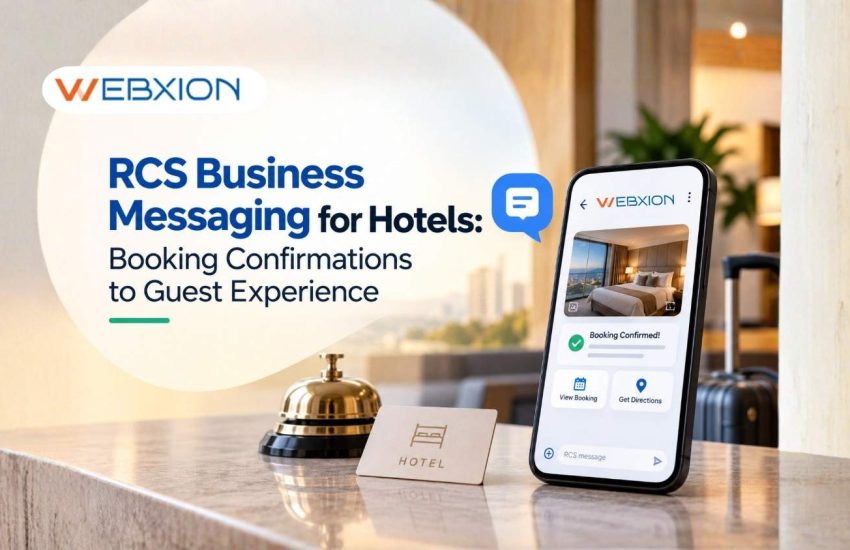
a guest can receive a branded message containing the hotel name, property image, reservation details and actions such as View Booking, Get Directions, Contact Hotel or Modify Reservation.
This makes RCS particularly useful for hospitality because hotels regularly communicate information that benefits from visual and interactive presentation.
RCS vs SMS for Hotel Communication
Feature | SMS | RCS |
Plain-text messaging | Yes | Yes |
Hotel branding | Limited | Yes |
Images | Limited/URL dependent | Yes |
Rich cards | No | Yes |
Interactive buttons | Limited | Yes |
Suggested replies | No | Yes |
Conversational experience | Basic | Advanced |
Hotel room showcase | No | Yes |
Interactive guest journeys | Limited | Yes |
The important distinction is that RCS can turn a notification into an actionable conversation.
Why Should Hotels Use RCS Business Messaging?
Hotels compete not only on rooms and prices but also on convenience and guest experience. Communication plays an important role in that experience.
A guest who can quickly confirm a reservation, ask for airport pickup or request late checkout without searching through emails has a smoother journey.
RCS can help hotels:
- Improve booking communication
- Reduce repetitive front-desk queries
- Deliver important information at the right time
- Showcase rooms and hotel facilities visually
- Automate common guest requests
- Promote relevant services
- Support direct booking journeys
- Increase engagement with hotel communications
- Connect transactional and conversational messaging
For example, instead of sending a separate SMS with a hotel address, an RCS message can provide the address with a Get Directions action. Instead of describing room upgrades in plain text, the hotel can present available options using rich content.
How Can RCS Transform the Hotel Guest Journey?
The strongest use of RCS is across the entire guest lifecycle—not just booking confirmation.
1. Before Booking: Answer Guest Questions
Hotels can use RCS conversations to help potential guests find information before they book.
A guest could ask:
- Do you have family rooms?
- Is breakfast included?
- Do you provide airport transfers?
- Is parking available?
- How far is the hotel from the airport?
- What are your check-in and check-out times?
Suggested replies can guide the conversation without requiring the guest to type every question.
This is particularly useful for hotels receiving enquiries through digital marketing campaigns, websites and mobile searches.
2. During Booking: Showcase Rooms and Offers
Room selection is naturally visual.
Hotels can use rich cards to display:
- Room photographs
- Room category
- Occupancy
- Amenities
- Pricing information
- Available packages
- Booking actions
For example, a resort could present three room categories in a carousel: Deluxe Room, Premium Suite and Family Villa.
Each option can provide relevant information and a booking action.
The objective is simple: reduce the number of steps between interest and reservation.
3. Booking Confirmation: Make the Reservation Easy to Access
Booking confirmation is one of the most valuable transactional RCS use cases.
A useful confirmation can include:
- Guest name
- Hotel name
- Booking ID
- Check-in date
- Check-out date
- Room type
- Number of guests
- Payment status
- Cancellation information
- Hotel address
- Contact option
- Manage Booking button
- Directions
Instead of searching through an email inbox, the guest has the essential information directly inside the conversation.
4. Pre-Arrival: Prepare Guests Before They Reach the Hotel
The period between booking and arrival creates several opportunities for useful communication.
Hotels can send:
- Welcome messages
- Check-in instructions
- Directions
- Airport transfer options
- Parking information
- Early check-in options
- Restaurant booking options
- Spa appointments
- Special-request confirmations
For example:
“Your stay begins tomorrow. Would you like us to arrange airport pickup?”
Suggested actions could include Yes, Arrange Pickup, View Options, and Contact Hotel.
This is more useful than sending a generic reminder with a phone number.
5. Check-In: Reduce Arrival Friction
Hotels can use RCS to send check-in reminders and arrival information.
Depending on the hotel’s technology stack, the conversation may provide access to:
- Digital check-in
- Reception instructions
- Parking information
- Wi-Fi details
- Property maps
- Room-ready notifications
- Mobile key or relevant digital access
The goal is not to eliminate human hospitality. It is to remove repetitive administrative steps so hotel staff can spend more time helping guests.
How Can RCS Work as a Digital Concierge?
One of the most practical applications is in-stay guest support.
Instead of calling reception for every small request, guests can interact with the hotel through messaging.
A guest could select:
Room Service | Housekeeping | Maintenance | Restaurant | Spa | Concierge
They could then request extra towels, enquire about restaurant timings or ask for assistance.
For hotels with multiple properties or high guest volumes, automated responses can handle common questions while more complex requests are transferred to hotel staff.
This creates a hybrid model:
Automation for routine requests + human assistance for situations requiring personal attention.
How Can Hotels Use RCS for Upselling?
RCS can also support hotel revenue generation when offers are relevant to the guest.
Hotels can promote:
- Room upgrades
- Breakfast packages
- Spa treatments
- Restaurant reservations
- Airport transfers
- Late checkout
- Experiences
- Premium amenities
For example, after a guest books a standard room, the hotel could send a personalized upgrade option:
“Make your stay more comfortable with our Premium Room upgrade. Enjoy additional space and enhanced amenities.”
The message can include an image and an Upgrade My Room action.
The key is relevance. Sending every guest the same promotional message can make communication feel like advertising rather than hospitality.
What Are the Best RCS Use Cases for Hotels?
The most practical hotel RCS applications include:
- Booking confirmations
- Reservation modifications
- Cancellation notifications
- Payment updates
- Check-in reminders
- Room-ready alerts
- Digital concierge services
- Restaurant reservations
- Spa bookings
- Airport transfer coordination
- Room-service requests
- Room upgrades
- Checkout reminders
- Digital invoices
- Review requests
- Loyalty communication
Hotels should prioritize use cases according to guest needs rather than attempting to automate everything at once.
RCS Rich Cards and Carousels for Hotel Marketing
Hotels are highly visual businesses, making rich media especially valuable.
A conventional message might say:
“Upgrade to our executive suite for ₹8,500.”
An RCS experience can present the suite image, key amenities, description and a direct action.
Carousels are useful when several options need to be compared.
For example:
Room Options
- Deluxe Room — 2 Guests
- Executive Room — 2 Guests
- Family Suite — 4 Guests
Each card can guide the guest toward more information or booking.
This can make RCS useful for both hotel marketing and transactional communication.
Can Hotels Use RCS Chatbots?
Yes. RCS can support conversational hotel experiences where automated responses handle predefined guest journeys.
An RCS hotel chatbot can help with:
- FAQs
- Booking enquiries
- Reservation information
- Hotel facilities
- Check-in instructions
- Restaurant information
- Spa bookings
- Directions
- Service requests
However, automation should not become a barrier.
If a guest asks something outside the automated flow, the system should provide an appropriate route to human support.
For hospitality, the best chatbot is not necessarily the one that automates the most conversations. It is the one that solves routine requests while making human assistance easy when needed.
How Can Hotels Automate RCS Communication?
RCS becomes significantly more valuable when connected with hotel technology.
A typical workflow can look like:
Booking System → Trigger → RCS Message → Guest Action → Automated Response → Staff Handover
For example:
A reservation is created → booking system triggers confirmation → guest receives RCS message → guest selects “Airport Transfer” → available options are displayed → guest confirms → hotel team receives the request.
The same approach can support pre-arrival reminders, payment notifications and post-stay feedback.
Integrating RCS with CRM, PMS, booking engines and customer-support systems can help create consistent communication across the guest lifecycle.
RCS vs WhatsApp for Hotels: Which Is Better?
RCS and WhatsApp can both support rich, conversational communication, but hotels should not automatically treat them as direct substitutes.
The right channel depends on the hotel’s audience, existing customer behavior, geography, infrastructure and communication strategy.
A hotel may use multiple channels:
- RCS for supported rich messaging experiences
- WhatsApp for conversational customer engagement
- SMS for broad transactional reach and fallback
- Email for detailed documents and longer communications
- Voice for situations requiring direct assistance
A strong hospitality communication strategy is often multi-channel rather than channel-exclusive.
RCS for Hotels in India
India’s hospitality sector includes luxury hotels, business hotels, resorts, boutique properties, budget accommodation and large hotel chains.
Guests increasingly interact with businesses through mobile-first channels, making conversational messaging relevant for hotels targeting Indian travelers.
For hotels in Pune, Mumbai, Delhi, Bengaluru, Hyderabad, Chennai, Ahmedabad and other major Indian markets, RCS can support communication around reservations, check-in, transportation, dining and promotional offers.
For example, a hotel in Pune could use RCS to send a booking confirmation followed by directions, airport-transfer information and restaurant recommendations.
The same approach can be adapted for resorts in Goa, business hotels in Mumbai or hospitality groups operating across multiple Indian cities.
Local relevance should be based on actual service coverage and customer behavior rather than adding city names purely for SEO.
What Are the Best Practices for Hotel RCS Messaging?
Successful RCS campaigns require more than attractive messages.
Keep Messages Useful
Transactional messages should prioritize the information the guest needs.
Use Clear CTAs
Actions such as View Booking, Get Directions, Upgrade Room and Contact Hotel are clearer than generic “Click Here” buttons.
Personalize Responsibly
Use booking details and guest preferences where appropriate, but avoid excessive personalization that feels intrusive.
Avoid Message Overload
A guest should not receive multiple unnecessary promotional messages during a short stay.
Maintain Human Support
Always provide an escalation path for requests that require hotel staff.
Provide Fallback Options
RCS availability can vary by device, carrier and market. Hotels should design appropriate fallback communication where required.
How Should Hotels Measure RCS Performance?
Hotels should measure RCS against business outcomes, not simply message volume.
Useful KPIs include:
- Delivery rate
- Read rate
- Response rate
- CTA engagement
- Booking conversions
- Direct booking conversions
- Room upgrade conversions
- Service-request completion
- Support resolution rate
- Guest feedback
- Revenue generated from messaging
For example, if an RCS room-upgrade campaign generates fewer clicks but significantly higher-value conversions, it may be more commercially effective than a campaign generating thousands of low-intent interactions.
Common RCS Mistakes Hotels Should Avoid
Hotels often make the mistake of treating RCS as SMS with pictures.
Other problems include:
- Too many promotional messages
- Poor-quality room images
- Unclear calls to action
- Complicated conversational flows
- No human support option
- Lack of PMS or CRM integration
- Irrelevant offers
- Ignoring guest preferences
- Failing to test the complete booking journey
The best RCS strategy starts with a guest problem and then determines whether messaging can solve it.
How Can WebXion Help Hotels With RCS Business Messaging?
Implementing RCS successfully requires more than sending rich messages. Hotels need a communication strategy, automation, integrations and reliable messaging infrastructure.
WebXion can help hospitality businesses build a broader customer communication ecosystem using services such as RCS Business Messaging, WhatsApp Business API, Bulk SMS Reseller Services, Outbound Voice Calls services, Missed Call Services and AI ChatBots services.
For hotels, this can support journeys such as:
Booking → RCS Confirmation → Pre-Arrival Message → Guest Support → Upselling → Checkout → Feedback
WebXion can also help businesses explore API-based communication and multi-channel messaging strategies based on their operational requirements.
For hotel groups and hospitality businesses managing multiple locations, the strategy can be designed around centralized communication while still delivering location-specific information.
Ready to Build a Better Guest Communication Experience?
Hotel communication should not end with a booking confirmation. Every message is an opportunity to make the guest journey easier—from the moment a reservation is made to the moment the guest checks out and considers returning.
If your hotel, resort or hospitality group wants to explore RCS Business Messaging, hotel booking notifications, conversational chatbots or multi-channel customer communication, speak with WebXion.
Build an RCS strategy around your actual guest journey, connect the right systems, automate repetitive communication and give guests faster access to the information and services they need.
Contact WebXion to discuss an RCS Business Messaging solution tailored to your hotel’s booking, guest-service and customer-engagement requirements.