Summary – A missed call service is usually better when the goal is to generate a high volume of leads with minimal customer effort. IVR is more effective when businesses need to qualify leads, collect information, or route callers to the right team. For many businesses, combining missed calls with IVR, CRM integration, and automated follow-ups creates the strongest lead-generation system.
Getting a potential customer to show interest is only half the job. The bigger challenge is capturing that interest quickly and turning it into a sales opportunity.
That is why businesses often compare missed call services and IVR systems for lead generation.
Both use voice communication, but they solve different problems. A missed call service makes it extremely easy for someone to respond to an advertisement or campaign. IVR, on the other hand, creates an interactive voice journey where callers can select options, provide information, and reach the right department.
So, which one is better for lead generation?
The answer depends on what you want to achieve: more leads, better-qualified leads, faster follow-up, or a combination of all three.
What Is the Difference Between Missed Call Service and IVR?
The simplest difference is this:
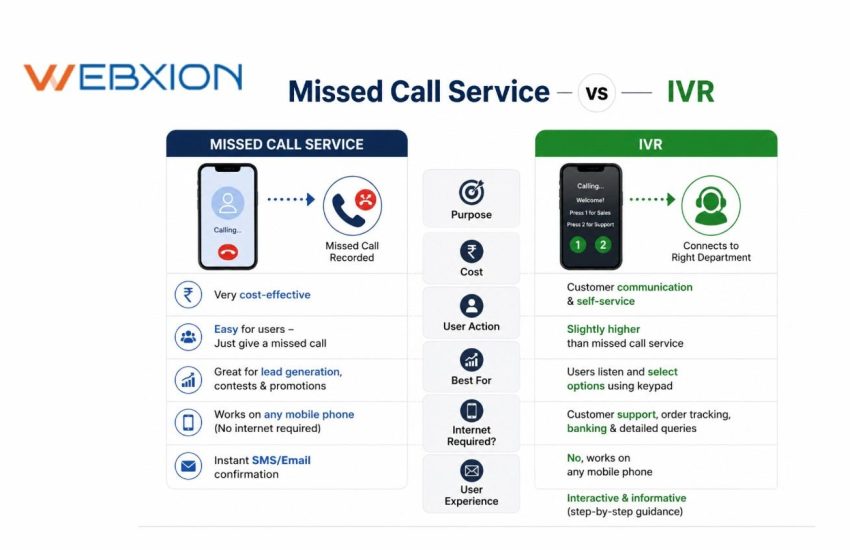
A missed call service focuses on capturing customer interest, while IVR focuses on interacting with and qualifying the caller.
With a missed call campaign, a business displays a dedicated phone number. A customer gives a missed call, the system identifies the caller’s number, and the business can automatically trigger an SMS, WhatsApp message, callback, or CRM workflow.
IVR, or Interactive Voice Response, works differently. The customer calls a business number and hears a recorded menu such as:
“Press 1 for sales, Press 2 for support, Press 3 for an appointment.”
The caller’s response can determine where the call goes next.
For example, a real estate company could use a missed call campaign to collect inquiries from a property advertisement. IVR could then be used to ask whether the customer is interested in buying, renting, or selling before connecting them with the appropriate team.
That distinction becomes important when choosing a lead-generation strategy.
How Does a Missed Call Service Generate Leads?
A missed call service removes many of the barriers associated with traditional lead forms.
Imagine a real estate advertisement that says:
“Interested in this property? Give us a missed call on 1800-XXX-XXXX.”
The customer does not have to fill out a form, remember a website address, or wait for an agent.
They simply call.
The typical process looks like this:
- The customer sees an advertisement.
- The customer gives a missed call to the campaign number.
- The system captures the caller’s number.
- The call is automatically disconnected or handled according to the campaign setup.
- The lead is recorded.
- An SMS, WhatsApp message, or callback can be triggered.
- The lead can be pushed into a CRM.
- A sales representative follows up.
This is particularly useful for mobile-first audiences in India, where customers may prefer a quick phone interaction rather than completing a long online form.
It can also work well for newspaper advertisements, billboards, radio promotions, television campaigns, product packaging, election-awareness campaigns, education advertisements, and local business promotions.
Why Is Missed Call Lead Generation So Effective?
The biggest advantage is low customer effort.
A customer may ignore a form asking for their name, email, location, and other information. But responding to a missed-call number takes only a few seconds.
For example, an education company promoting a new course in Pune could advertise:
“Want course details? Give us a missed call.”
Once the student calls, the organization can automatically send course information through SMS or WhatsApp and assign the lead to an admission counsellor.
The same approach can work for:
- Real estate property inquiries
- Insurance leads
- Loan inquiries
- Automobile test-drive requests
- Healthcare appointments
- Education admissions
- Retail promotions
- Consumer campaigns
- Local service businesses
The important point is that a missed call should not be treated as the end of the campaign. It should be the beginning of the follow-up journey.
How Does IVR Generate and Qualify Leads?
IVR takes the voice interaction one step further.
Instead of simply recording that someone called, an IVR system can ask the caller what they need.
For example:
“Welcome to ABC Realty. Press 1 to buy a property, Press 2 to rent a property, or Press 3 to speak with an agent.”
The caller’s selection provides useful intent data.
A more advanced IVR flow could ask:
- Which service are you interested in?
- Which city are you located in?
- Are you a new or existing customer?
- Would you like a callback?
- Which product category interests you?
The system can then route the caller accordingly.
This makes IVR particularly useful when lead qualification and call routing are more important than simply generating a large number of responses.
Missed Call Service vs IVR: Which Is Better for Lead Generation?
There is no universal winner. Each solution performs better in different situations.
1. Which Is Easier for Customers?
Missed call service wins.
The customer has to perform only one simple action: call the number.
There are no menus to navigate and usually no long interaction.
That makes missed calls particularly effective for mass campaigns where the goal is to encourage as many people as possible to respond.
2. Which Is Better for Lead Qualification?
IVR wins.
IVR can ask questions and route customers based on their responses.
For example, an insurance company can separate callers interested in health insurance from those interested in motor insurance before sending them to the relevant team.
This reduces unnecessary transfers and gives sales representatives more context.
3. Which Can Generate More Leads?
Missed call service generally has the advantage.
Because the interaction is simple, it can work especially well with high-volume campaigns.
A customer seeing a billboard in Mumbai, for example, may be far more willing to give a missed call than scan a QR code, visit a website, and complete a form.
4. Which Provides Better Lead Information?
IVR generally provides more information at the initial interaction.
A missed call initially gives the business the caller’s phone number and campaign information. Additional information can then be collected through SMS, WhatsApp, IVR, or a sales callback.
IVR can gather intent immediately.
5. Which Is More Cost-Effective?
The answer depends on campaign requirements.
Missed call services can be highly cost-efficient for large-scale lead capture because the interaction is short.
IVR may involve additional telephony and call-handling costs, particularly when callers spend more time navigating menus or speaking with agents.
Businesses should therefore measure cost per lead and cost per qualified lead, rather than looking only at the cost of the communication channel.
Missed Call Service vs IVR: Quick Comparison
Factor | Missed Call Service | IVR |
Customer effort | Very low | Moderate |
Lead generation | Excellent | Good |
Lead qualification | Basic | Advanced |
Customer interaction | Minimal | Interactive |
Lead volume | High | Moderate to high |
Call routing | Limited/basic | Strong |
CRM integration | Yes | Yes |
Automated follow-up | Yes | Yes |
Best for | Mass lead capture | Qualification and routing |
Ideal campaign | Promotions and advertising | Sales and support workflows |
When Should You Choose a Missed Call Service?
Choose a missed call service for lead generation when your main objective is to make it extremely easy for customers to respond.
It is a strong option when:
- You are running large advertising campaigns.
- Your audience is primarily mobile users.
- You want to capture leads from offline advertising.
- You need campaign-wise tracking.
- You want quick customer participation.
- You plan to follow up through SMS or WhatsApp.
- You want to connect leads with a CRM.
- You are targeting customers across multiple Indian cities or regions.
For example, a property developer advertising across Delhi, Mumbai, Pune, and Ahmedabad could use different missed-call numbers for different campaigns. This makes it easier to identify which campaign generates the most inquiries.
When Is IVR Better for Lead Generation?
Choose IVR for lead generation when customer intent needs to be understood before the sales team gets involved.
IVR works particularly well for:
- Banking and financial services
- Insurance
- Healthcare
- Telecom
- Education
- Real estate
- Travel
- Automobile businesses
- Large customer-support operations
Consider a healthcare organization receiving thousands of calls.
An IVR could separate:
Press 1 – Book an appointment
Press 2 – Check appointment status
Press 3 – Speak with support
Press 4 – Other inquiries
Instead of sending every caller to the same agent, the system organizes the interaction from the beginning.
Can You Use Missed Call Service and IVR Together?
Yes, and this is often the most effective approach.
Instead of asking whether missed call or IVR is better, businesses can use both at different stages of the customer journey.
A practical workflow could look like this:
Advertisement → Missed Call → Caller Identification → Automated Callback/IVR → Lead Qualification → CRM → Sales Follow-Up
For example, an education company can promote a missed-call number for admission inquiries.
After receiving the missed call, the system can trigger an automated IVR callback:
“Press 1 if you are interested in undergraduate courses. Press 2 for postgraduate courses. Press 3 to speak with an admission counsellor.”
Now the business has both lead volume and lead intent.
That combination can significantly improve the efficiency of sales follow-up.
How Can Businesses Improve Missed Call Lead Conversion?
Generating a lead is not enough. The next step determines whether that lead becomes revenue.
Here are practical strategies:
Respond Quickly
A missed call indicates interest at a specific moment. Delayed follow-up can reduce the chance of conversion.
Connect Missed Calls With CRM
Automatically push caller information into a CRM so sales teams do not have to manually enter every lead.
Use Automated SMS or WhatsApp Follow-Up
Send useful information immediately after the missed call instead of making the customer wait.
Track Campaign Sources
Use separate numbers or campaign identifiers for different advertisements.
This helps answer questions such as:
- Which campaign generated the most leads?
- Which city produced better-quality inquiries?
- Which advertisement generated the highest conversion rate?
Measure Qualified Leads, Not Just Calls
A campaign generating 10,000 missed calls is not necessarily better than one generating 5,000 calls if the second campaign produces more qualified customers.
Track:
- Total calls
- Unique callers
- Qualified leads
- Callback rate
- Conversion rate
- Cost per lead
- Cost per qualified lead
- Sales generated
What Are the Common IVR Mistakes to Avoid?
A poorly designed IVR can frustrate customers instead of generating better leads.
Avoid:
- Too many menu options
- Long recorded messages
- Complicated navigation
- Repeating the same information
- Poor call routing
- No option to reach a human agent
- Slow response times
- No CRM integration
Keep the first menu simple.
If customers need to press five or six buttons before reaching the right department, many may simply hang up.
Which Industries Benefit From Missed Call Lead Generation?
Missed call campaigns are particularly useful where customers need a quick way to express interest.
Real estate: property inquiries and site-visit requests.
Education: admission and course inquiries.
Healthcare: appointment requests.
Automobile: test-drive requests.
Insurance: policy inquiries and callbacks.
Retail and FMCG: promotional campaigns and consumer engagement.
Local businesses: service inquiries and callback requests.
This flexibility makes missed call marketing useful for both national campaigns and local lead generation in cities such as Mumbai, Pune, Delhi, Bengaluru, Hyderabad, Chennai, Ahmedabad, and Jaipur.
How Should You Choose Between Missed Call Service and IVR?
Use this simple decision rule:
- Choose missed call service when you want more responses with less customer effort.
- Choose IVR when you need to qualify, categorize, and route callers.
- Choose both when you want to capture a large number of leads and qualify them before sales follow-up.
For most businesses, the decision should not be based only on technology cost. Look at the entire customer journey—from advertisement response to CRM entry and final conversion.
Ready to Turn Missed Calls Into More Qualified Leads?
A Missed Call Service is ideal for quick, high-volume lead capture, while IVR helps businesses qualify callers, route inquiries, and automate conversations. When combined with CRM integration and timely follow-ups, both can become a powerful lead-generation system.
Businesses can further strengthen customer communication with a IVR Calls Services, WhatsApp API Provider, RCS Service Provider, Promotional Voice Calls Service, Bulk Voice Calling Service, AI Voice Bot Services, and AI Chatbot Software. For authentication and notifications, solutions such as OTP SMS Service, Transactional SMS Service, SMS Notification Service, Voice OTP Delivery Services, and SMPP Server Service can support reliable communication.
For enterprises and resellers, Bulk SMS Reseller Services, Transactional Voice Calls Reseller, Toll-free number provider, and Outbound Voice Calls services can help build a scalable communication strategy. Businesses in India should also consider DLT Registration and applicable compliance requirements.
If you want to connect voice, SMS, WhatsApp, RCS, and AI solutions into one effective customer communication strategy, Connect with WebXion to explore the right solution for your business.
Frequently Asked Questions
Is missed call service better than IVR for lead generation?
For high-volume lead capture, missed call service is generally better because it requires very little customer effort. IVR is better when the business needs to qualify leads or route callers based on their requirements.
Can missed call services integrate with CRM systems?
Yes. Depending on the platform, missed call systems can connect with CRM software through APIs, webhooks, or other integrations to automatically create and manage leads.
Can IVR qualify leads automatically?
Yes. IVR can collect information through keypad selections or voice interactions and use those responses to categorize or route leads.
Can missed call service and IVR work together?
Yes. A business can use a missed call to capture initial interest and then use an automated IVR callback to qualify the lead.
Which is cheaper: missed call service or IVR?
It depends on the campaign structure, call volume, infrastructure, and follow-up requirements. Missed call campaigns are generally well suited to high-volume, low-interaction lead capture, while IVR is more appropriate when additional voice interaction is required.
What is the biggest benefit of missed call lead generation?
The biggest advantage is simplicity. Customers can express interest without filling out a form, installing an application, or spending significant time on a call.